
Gut and digestive
Unlock Your Reflux
You have been told it is too much acid, you have been taking something for it for years, and it is still here. Maybe it eases and then returns the moment you lie down, or the moment a meal runs late, or the moment a week gets hard. Somewhere along the way the burning stopped being an event and became a background condition you plan your evenings around. That is worth investigating properly rather than managing indefinitely, because up to half of people remain symptomatic despite adequate acid suppression.
Educational and screening-oriented. Nothing here is a diagnosis.

Recognition
Does this sound like you
Acid is what makes reflux hurt. It is almost never what makes reflux happen, which is why the pattern of your days usually tells you more than the burning itself does.
- Mealtime has become something you brace for, and you have been reaching for antacids for years for relief that arrives fast and never lasts.
- Symptoms show up when you bend, lift, cough, strain, or fasten a tight waistband, and they are worse lying flat and better standing up.
- You wake in the night burning, or with a sour taste at the back of your throat, and the tiredness the next day gets blamed on everything except the reflux that interrupted your sleep.
- Bloating, belching, and the sense that a meal is just sitting there begin shortly after you eat, and the fullness lasts far longer than it should.
- Your list of foods to avoid keeps growing, coffee, tomato, citrus, chocolate, mint, and the list gets longer while the symptoms stay exactly where they were.
- You have been on acid suppression for years, it takes the edge off without ending anything, and nobody has revisited whether you still need it or checked what it may have cost your B12, iron, or magnesium.
What actually gets looked at
Five drivers, and the two most often missed have no blood test
There is no blood test for reflux itself. It is diagnosed clinically and confirmed, when it matters, by endoscopy or pH testing. That is not a reason to skip testing. It is a reason to test the right things: what is treatable underneath the reflux, what imitates it and is managed completely differently, and what the reflux or its treatment has already cost you.
The mechanical barrier
The anti-reflux barrier is not one valve but three parts working together: the lower esophageal sphincter, the crural diaphragm wrapped around it, and the flap valve formed by the angle where the esophagus enters the stomach. The diaphragm works as an external sphincter, raising sphincter pressure with every breath in and during any rise in abdominal pressure, and a sliding hiatus hernia pulls the sphincter up out of its grip. No blood test shows any of this. I assess it through your symptom pattern, how you breathe, and what happens to your abdomen under load, which is why a structural assessment belongs in a reflux workup.
The nervous system's volume
The same amount of reflux can be a minor sensation in one person and a disabling one in another, and that difference is a real physiological finding rather than a polite way of saying the pain is imaginary. Esophageal hypervigilance shows up across reflux presentations regardless of acid burden, and it predicts symptom severity independently. Sleep runs in both directions with reflux, each one worsening the other, and snoring or waking unrefreshed is a reason to ask about a sleep assessment, since treating apnea can improve the reflux. None of this is blood work. It is history, sleep, and tracking symptoms against stress rather than against food alone.
H. pylori, first
This is the first thing I want ruled in or out, because it is common, treatable, and genuinely consequential. The two non-invasive options are the urea breath test and the stool antigen test. A blood antibody test is the weak one, because it can stay positive after successful treatment and cannot separate a current infection from a past one. The detail that ruins this test is timing: acid suppression and antibiotics produce false negatives, so a washout period is required and your clinician sets the interval. If you are treated, eradication is verified by retesting afterward rather than assumed.
The imitators
Reflux is the default label applied before anyone looks, and two of its imitators are managed completely differently. Eosinophilic esophagitis is diagnosed only by biopsy at endoscopy, so no blood test rules it in or out, and in a multicenter study of people presenting with food stuck in the esophagus, biopsies were taken in only 52% of cases, while most of those who were biopsied received a new diagnosis. Celiac serology has to be drawn while you are still eating gluten or it is uninterpretable. And new chest pain deserves a cardiac evaluation before it is ever filed under heartburn.
The low acid question
Functional medicine often frames reflux as too little acid rather than too much, and I handle that claim carefully, because it is the most repeated idea in reflux content and it is not as settled as it is usually presented. Low acid is real, defined, and testable. The workup I would actually run, if it is genuinely on the table, is the autoimmune gastritis panel: parietal cell and intrinsic factor antibodies, gastrin, and pepsinogen I and II with the ratio, alongside B12 and iron. Demonstrate the deficit before treating it, because adding acid to an ulcer or active gastritis can hurt you.
What the medication took
This is the part most often skipped. Stomach acid is required to liberate B12 from food protein, which is why long-term acid suppression is associated with B12 deficiency, and iron, magnesium, and calcium sit alongside it on the standard list of long-term harms. Iron matters twice over, because an ulcer or an inflamed esophagus can bleed slowly enough that you never see it, and iron deficiency anemia may be the first sign of that. If you have been on acid suppression for more than a year and nobody has checked, that is the single most reasonable request you can make at your next appointment.
Honest limits
The most repeated claims here are the least settled
The claim you will meet everywhere in this corner of health content is that reflux is caused by too little stomach acid rather than too much. Low acid is real, defined, and testable, and where it has been demonstrated, replacing it has a coherent rationale. The strongest published case is made for autoimmune gastritis, a condition in which the cells that produce acid have been destroyed. What that does not support is the broader claim that most people with reflux have low acid, and that version does not have trial evidence behind it. The at-home betaine challenge, where you add capsules until you feel warmth, is widely described and is not a validated test, and adding acid to an ulcer or an inflamed esophagus can hurt you. Those are exactly the conditions that produce the symptoms sending people to look for it. So the instruction I give is a simple one: demonstrate the deficit before you treat it.
The other one is the trigger list. When researchers applied an evidence grading system to the standard lifestyle advice for reflux, covering coffee, citrus, chocolate, spicy food, alcohol, and the rest, they found no published evidence of efficacy for dietary measures. What survived that review was weight loss and raising the head of the bed, neither of which requires a product and neither of which is exciting. That does not mean your reactions are imaginary. It means the list is a set of candidates to test on yourself rather than a set of rules to obey. Run it as a short structured experiment with a diary, a baseline week followed by removing your top three candidates and then reintroducing them one at a time, and expect the answer to be two or three items. If you finish avoiding twelve foods, the method failed, not your esophagus.
So part of the work is subtraction. Separating what the evidence actually supports from what is simply repeated most often, deciding which findings matter in your specific case, and being willing to conclude that acid was never the main problem here. That is a real possible outcome and a useful one, because it points at the driver that is actually yours instead of the one everyone assumes. Nothing in this process asks you to stop or change a prescription. Coming off long-term acid suppression is done with a taper, a bridge, and the prescriber who wrote it, and if symptoms genuinely return and stay, the medication was doing a job.
Start with the pattern, not the prescription
The assessment maps your symptoms across systems in a few minutes. The discovery session is a straight conversation about which of the five drivers your picture looks like, what would be worth investigating first, and what probably does not apply to you. If you would rather begin on your own tonight, raise the head of your bed and start a symptom and meal diary, because in reflux the timing between a meal, a position, and a symptom is the most informative thing you can collect. Consultations and ongoing care are both available wherever you are located, and being outside North Carolina is not a barrier to working with me.
Prefer to start on your own?
Take the guides with you
The same clinician-written material, as an instant download. Covers below are the actual files you receive.

The ebook
$27
Unlock Your Reflux, 34 pages
- The keys to understanding it: what is actually going on, in plain language
- The evidence and its limits, stated honestly rather than oversold
- An actionable plan to work through, and what to expect from it
The kit
$47
Three working guides, 72 pages
- Lab guide. Understanding Your Reflux Labs: which tests are worth running, and how to read what comes back
- Dietary support. The Reflux Diet Guide: what the evidence supports about eating with this condition
- Supplement support. The Reflux Supplement Guide: what has been studied, tiered by evidence, with the medication cautions that matter
The ultimate guide
$67
Everything above in one PDF, 104 pages
- The ebook and all three guides in one document, with a single contents page
- A bridge section that connects the understanding half to the doing half
- One file to keep, print, or take to an appointment
Instant download, yours to keep. Educational only; personalized care starts with a free Discovery Session.
Testing
You can order the labs yourself
If your physician will run the testing, ask them first. That is usually the cheaper route. If you would rather not wait, or you have already been told your labs are normal, many of the panels I use in practice can be ordered directly through my patient portal.
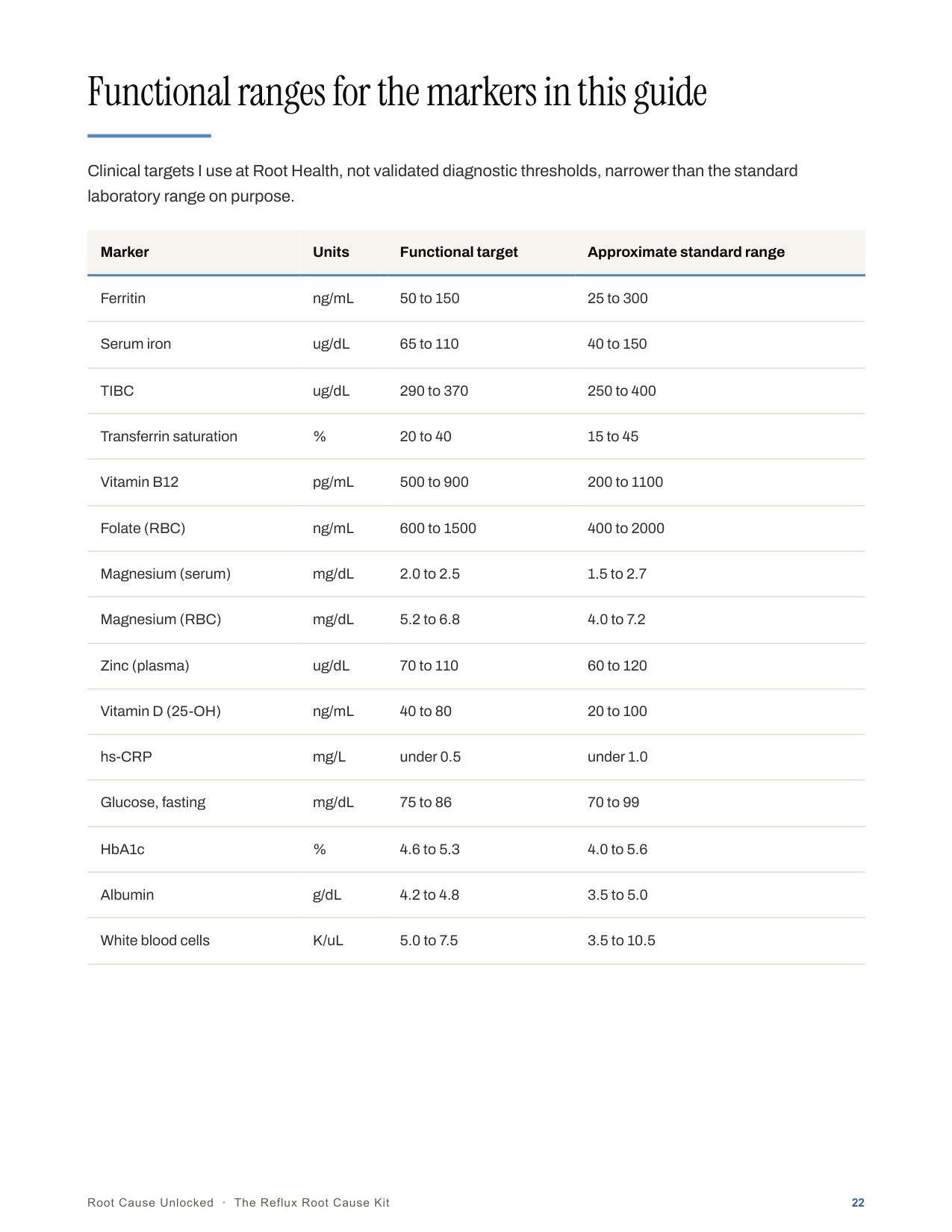
Ordering a test and knowing what to do with the result are two different things. Bring your results to your physician, or to a Discovery Session, before you act on them.