
Infection
Unlock Your Post Viral Recovery
You had the virus, and everyone around you moved on while you did not. Months later the fatigue is still there and sleep does not touch it, your brain works through fog by the middle of the afternoon, and your heart races when you stand up. The standard bloodwork came back essentially normal, you were told everything looks fine, and none of that matched what your body was actually doing. That gap is worth investigating carefully rather than explaining away.
Educational and screening-oriented. Nothing here is a diagnosis.

Recognition
Does this sound like you
Post-viral illness does not announce itself with a single abnormal number, which is a large part of why it gets missed. The pattern in how your symptoms behave, especially in the day or two after you exert yourself, usually tells you more than any panel does.
- You pay for a good day a day or two later. The crash arrives on a delay, it is out of proportion to whatever you actually did, and trying to build your stamina back has left you further behind than where you started.
- Standing up sets your heart racing. You are lightheaded in the shower, worse in heat, worse after a meal, and noticeably clearer within a minute of lying back down.
- You sleep eight or nine hours and wake as though you had not slept at all, and the fog settles in by mid-morning regardless. That is a different problem from insomnia, and it does not improve by going to bed earlier.
- Your bloodwork came back essentially normal, you were told everything looks fine, and nothing about that matched how you felt walking out of the building.
- An EBV panel came back with one antibody flagged high, chronic reactivated EBV became the explanation for everything, and a long protocol got built on top of that single result.
- You have become reactive to things that never used to bother you: certain foods, alcohol, fragrance, heat, sometimes medications, alongside bloating or changed bowel habits that nobody has connected to the fatigue.
What actually gets looked at
The two findings that matter most are not blood tests
There is no single laboratory result that confirms or rules out post-viral illness, which is exactly why ordering the biggest panel available produces noise rather than clarity. The workup is built in layers, and it starts with the two questions that shape everything after them: whether a crash reliably follows exertion, and what your heart rate does when you stand.
The delayed crash
This one is answered by history rather than by a panel, and it is the most consequential finding in the entire workup. Post-exertional malaise is a delayed, disproportionate worsening of fatigue, thinking, or pain that begins hours to a day or two after exertion that would not have troubled you before you got sick. It is not ordinary deconditioning and it is not a motivation problem. Where it is present, a standard graded exercise approach is not appropriate and pushing through causes harm. Establishing it first decides how activity, work, and even cooking get budgeted for the months that follow.
What happens when you stand
Lightheaded upright, racing when you stand, worse in heat, worse after meals, clearer lying down. That pattern gets found with a standing test in the office rather than with blood: ten minutes lying down while heart rate and blood pressure are recorded, then standing with readings taken at intervals over another ten minutes. A sustained heart rate rise of thirty beats per minute or more in adults on standing, without a fall in blood pressure, is the pattern to ask about by name. It takes about fifteen minutes, it needs no laboratory, and it is the item most often skipped.
The EBV panel, read properly
This is the most misread panel in the category, and a great deal of money gets spent on the back of the misreading. A positive VCA IgG alongside a positive EBNA-1 IgG is the signature of past infection, and roughly nine in ten adults carry that pattern. It is therefore not a diagnosis, and on its own it does not explain your fatigue. The height of an IgG titre is not a reliable measure of current viral activity. I run the panel once to establish serostatus if it has never been done, and I do not repeat it to track progress, because it will not track anything useful.
The deficiencies worth excluding
Common, correctable, and fully capable of producing exactly these symptoms: ferritin with a full iron panel, B12, RBC folate, homocysteine, vitamin D, and thyroid function with TSH plus free T4 and free T3. Ferritin is the one most often waved off, because a result sitting inside a laboratory's standard range still gets reported as normal. I read it against a narrower functional window instead. A complete blood count with differential and an inflammatory marker go alongside, with the honest caveat that in most post-viral presentations they are unremarkable, and a normal CRP does not mean nothing is wrong.
Reactivity and mast cells
If you have become reactive to foods, smells, medications, heat, and alcohol in ways you never were before, that belongs inside this workup rather than in a separate allergy conversation. A baseline serum tryptase is reasonable where reactions are systemic or involve more than one organ system, and a tryptase drawn during an actual event, compared against that baseline, is the informative one. The diagnostic discipline matters here, because the consensus criteria are strict and the looser alternatives circulating in practice often lack specificity and validation. Sorting this out changes what belongs on your plate before it changes anything else.
The gut and absorption
A large share of the immune system's tissue sits in and around the gut, so a significant viral illness tends to leave a mark there, and the digestive symptoms rarely get connected to the fatigue by anyone. The practical stake is absorption, because you cannot correct an iron or B12 deficiency through a gut that is not absorbing. Celiac serology comes first, and it has to be drawn while you are still eating gluten, since removing it beforehand costs you a clean answer. Stool analysis goes on the list only when gut symptoms genuinely justify it.
Honest limits
What is established here, and what is being oversold
Post-viral illness is real and it is common, and several of the explanations sold most confidently for it are still open questions. Whether viral material persists in tissue is an active research hypothesis rather than a settled fact, and there is no clinical test you can order to confirm or rule it out in yourself. The EBV reactivation link rests substantially on one small study whose own authors chose deliberately hedged language about what it showed, and I use the same hedge rather than upgrading it into a certainty. Mitochondrial involvement has genuine supportive signals in individual studies and remains inconsistent enough across the whole body of research that its exact role has not been established. Even the prevalence figures move depending on which definition a given study used.
The place this gets expensive is the EBV panel. A flagged IgG becomes chronic reactivated EBV, and a long antiviral protocol gets built on a result that roughly nine in ten adults would also produce. Genuine chronic active EBV disease does exist, and it is rare and severe, presenting with persistent fever and organ involvement rather than with fatigue alone, and it is diagnosed in specialist settings rather than with a supplement plan. So the practical move is straightforward: run that panel once for serostatus, stop repeating it, and put the effort into the two findings that actually direct care, which are whether exertion reliably produces a delayed crash and what your heart rate does after ten minutes on your feet.
So a real part of this work is subtraction. Deciding which findings actually explain your symptoms, declining the tests that will not change what you do next, and being willing to conclude that a post-viral mechanism is not what is driving this. That is a genuine and useful outcome, not a failed search. It is entirely possible that the answer is a correctable deficiency, a thyroid problem, or a sleep disorder that has been sitting underneath the whole time, and those are worth finding. Nothing in this process asks you to stop or change a prescription. That decision belongs to you and your prescribing clinician.
Start with the crash, not the panel
The assessment maps your symptoms across systems in a few minutes. The discovery session is a straight conversation about what that pattern suggests, which mechanisms your case actually points toward, and which testing would tell you something you do not already know. If tracking is where you would rather begin, a couple of weeks of honest exertion and symptom data makes any appointment, with me or with your own physician, far more useful than memory alone. Consultations and ongoing care are both available wherever you are located, and being outside North Carolina is not a barrier to working with me.
Prefer to start on your own?
Take the guides with you
The same clinician-written material, as an instant download. Covers below are the actual files you receive.
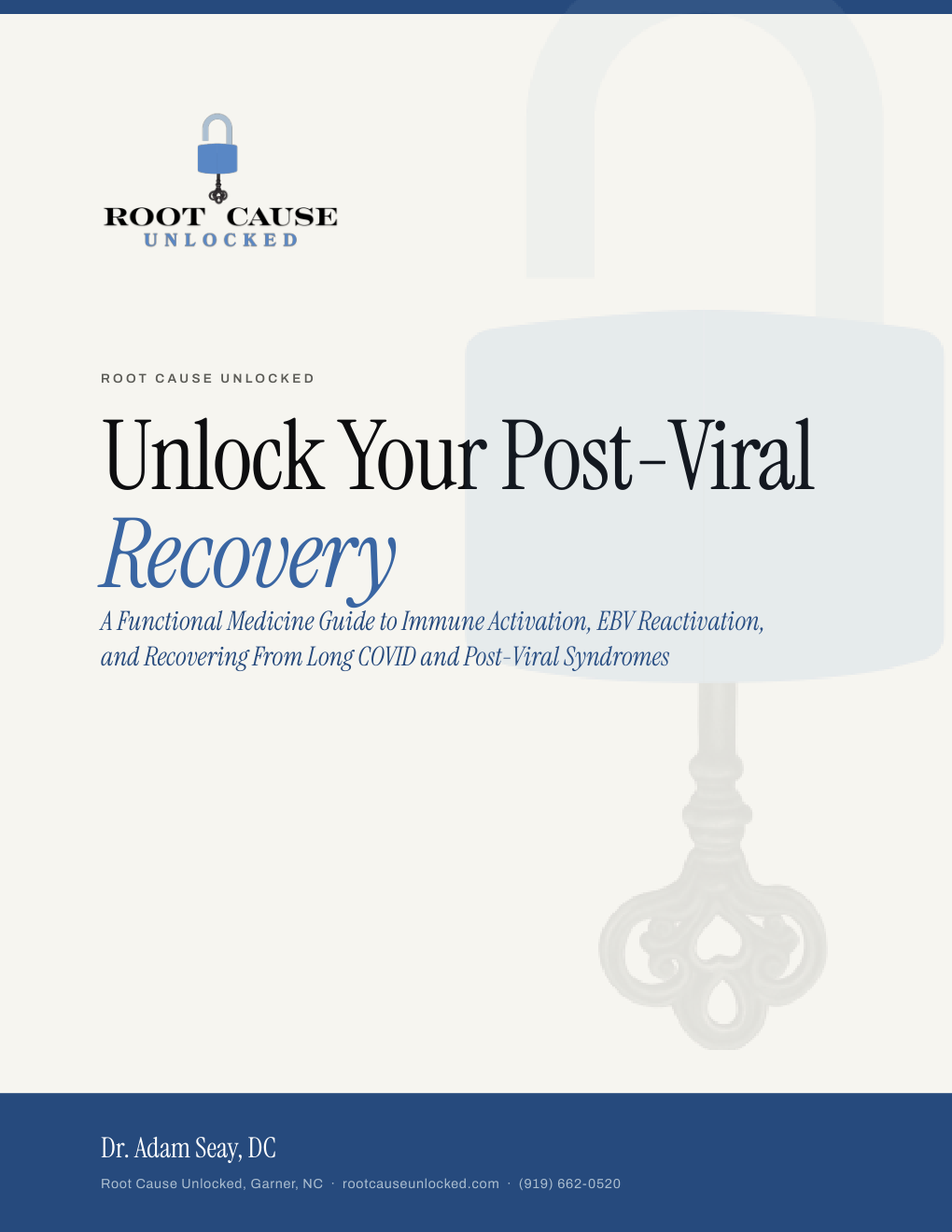
The ebook
$27
Unlock Your Post-Viral Recovery, 23 pages
- The keys to understanding it: what is actually going on, in plain language
- The evidence and its limits, stated honestly rather than oversold
- An actionable plan to work through, and what to expect from it

The kit
$47
Three working guides, 47 pages
- Lab guide. Understanding Your Post-Viral Labs: which tests are worth running, and how to read what comes back
- Dietary support. The Post-Viral Diet Guide: what the evidence supports about eating with this condition
- Supplement support. The Post-Viral Supplement Guide: what has been studied, tiered by evidence, with the medication cautions that matter
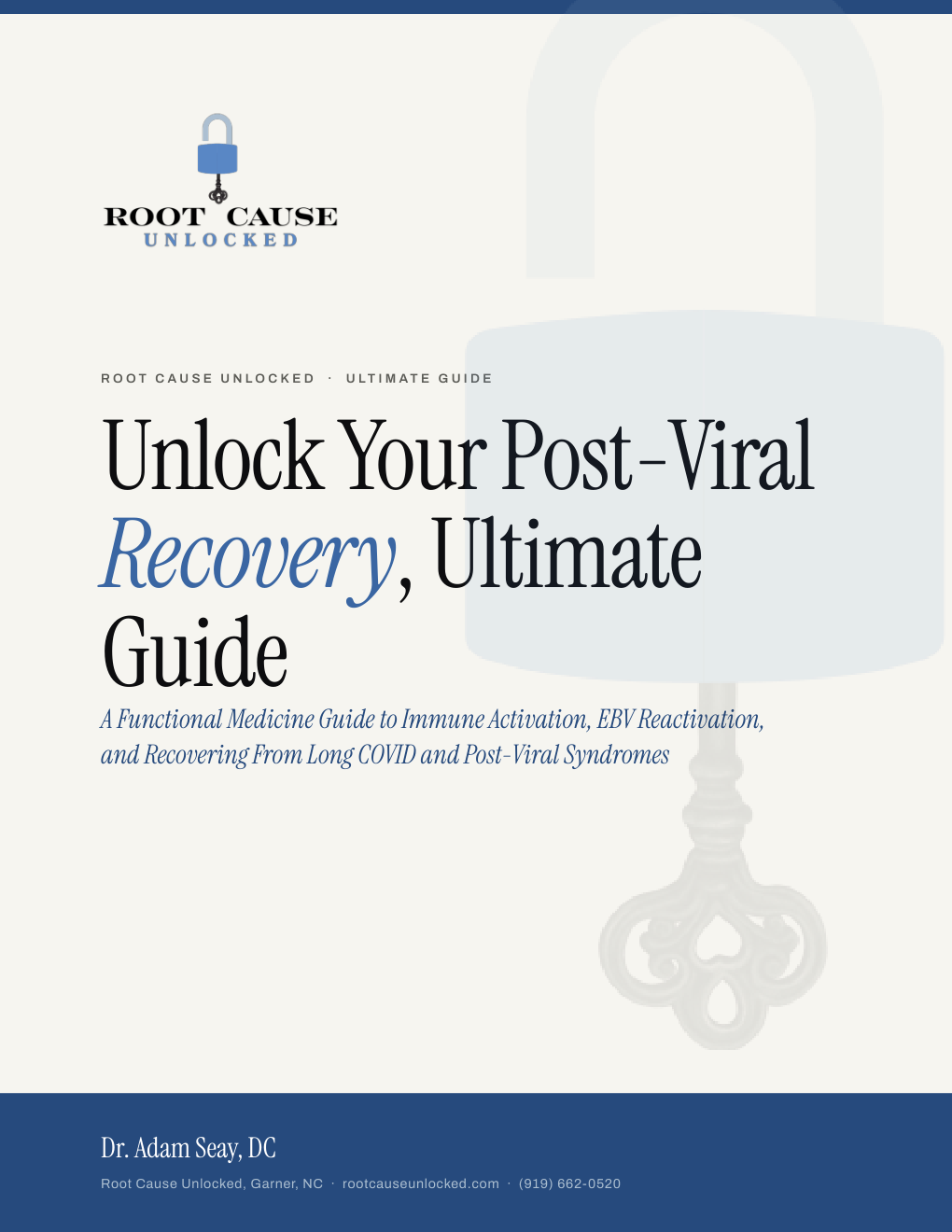
The ultimate guide
$67
Everything above in one PDF, 68 pages
- The ebook and all three guides in one document, with a single contents page
- A bridge section that connects the understanding half to the doing half
- One file to keep, print, or take to an appointment
Instant download, yours to keep. Educational only; personalized care starts with a free Discovery Session.
Testing
You can order the labs yourself
If your physician will run the testing, ask them first. That is usually the cheaper route. If you would rather not wait, or you have already been told your labs are normal, many of the panels I use in practice can be ordered directly through my patient portal.
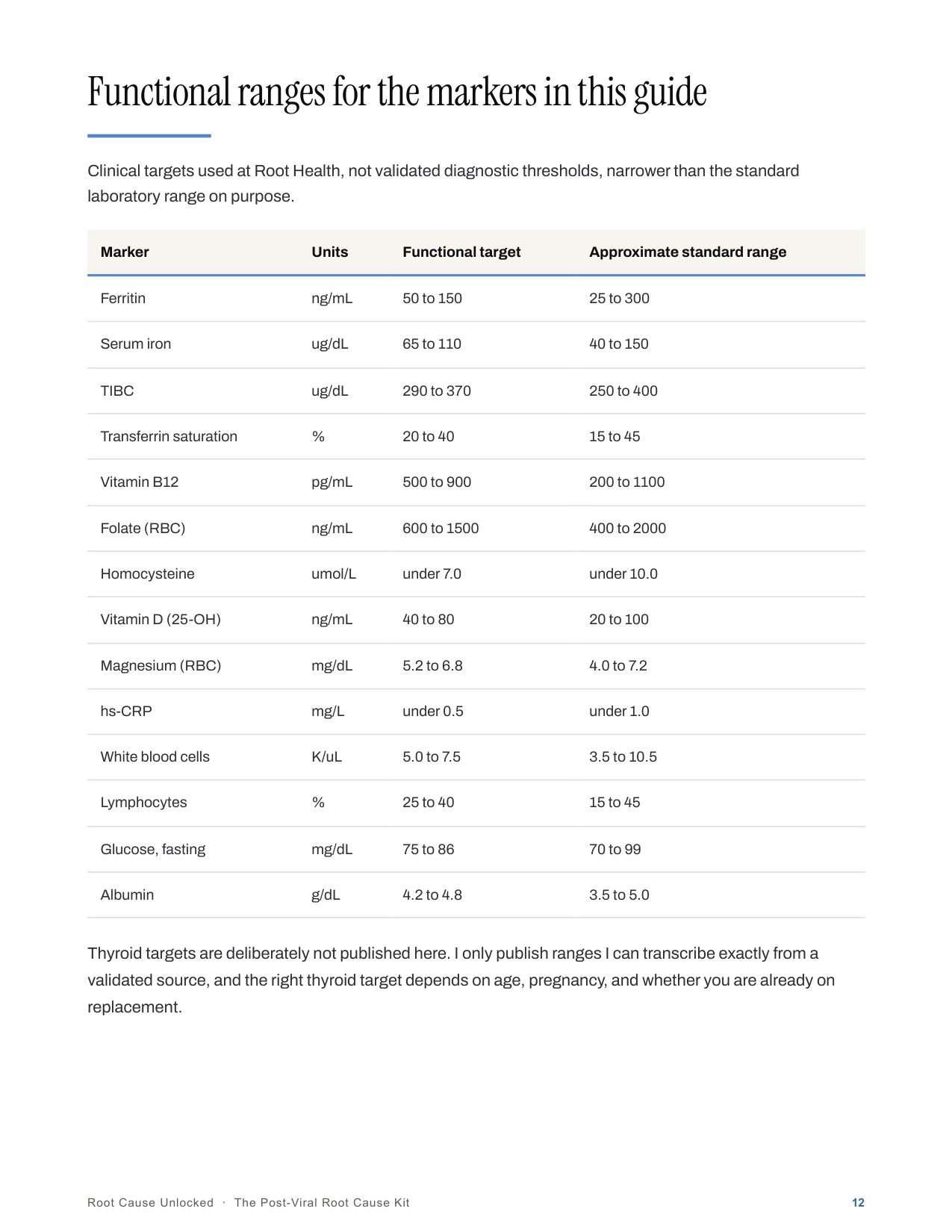
Ordering a test and knowing what to do with the result are two different things. Bring your results to your physician, or to a Discovery Session, before you act on them.