
Neurological
Unlock Your Migraines
You have been through the scans and they were clear. You have something that helps once an attack has started, and in all those years nobody has asked what is setting the attacks off in the first place. Migraine is not one problem with one answer, and the parts of it that can actually change tend to sit in your plate, your cycle, your neck, and your sleep rather than in any single test result. Finding which of those belong to you is a different project than managing the pain, and it starts with what you already know about your own attacks.
Educational and screening-oriented. Nothing here is a diagnosis.

Recognition
Does this sound like you
Migraine is diagnosed on pattern rather than on a blood result, so the shape of your attacks carries more information than any single panel will. Read these the way I would ask about them in the room.
- The attack is not simply a bad headache: throbbing pain, light and sound that become unbearable, nausea, sometimes an aura beforehand, and then a day afterward where you are functional but not really yourself.
- Your attacks cluster in the two days before your period and the first days of it, or the whole pattern shifted when you started a contraceptive, entered perimenopause, or were pregnant.
- You are taking something to stop a headache on more days than you would like to admit, counting the over-the-counter combination products and the ones with caffeine in them, and the attacks have quietly become more frequent rather than less.
- A meal slipping too late brings one on, and you wake with a headache on Saturday after a week of workday coffee at the same time every morning.
- You blamed a food once, usually chocolate or red wine, cut it out for good, and the attacks kept coming anyway.
- Neck pain, a jaw that clicks or that you catch yourself clenching, and a desk posture you hold for hours, none of which anyone has connected to what is happening in your head.
What actually gets looked at
Three of the five keys are not blood tests at all
Migraine is a clinical diagnosis, and there is no blood test for it. So blood work has two jobs here: finding the things that mimic or worsen migraine and are correctable, and finding the modifiable inputs that change how often attacks come. The rest of the assessment happens on a calendar, in an examination room, and in the diary you keep between visits.
Your acute medication days
The highest yield question in the whole workup is not a lab test. How many days a month do you take something to stop a headache, counting the over-the-counter combination products and the caffeine-containing ones. If that number is regularly 10 or more, medication overuse headache is likely part of your picture, and no supplement, diet, or panel will outperform addressing it. The research also cuts against the usual advice: withdrawal on its own was not effective, while withdrawal paired with a preventive strategy was. That makes this a conversation with a prescriber, and it usually reorders everything else on the list.
What the blood work finds
Blood work is not here to diagnose migraine. It is here to catch what is correctable. That means ferritin with serum iron, TIBC, transferrin saturation, and a CBC together, because ferritin alone rises with inflammation and can look reassuring in someone who is genuinely depleted, and because iron stores empty before the blood count changes. It means vitamin D, and TSH with free T4, since both an underactive and an overactive thyroid produce headache. And it means fasting insulin alongside glucose and HbA1c, because insulin moves years before glucose does and shows a metabolic picture that is already shifting.
The nutrient markers
Two markers carry more weight than the rest, in opposite ways. Homocysteine, with B12 and red cell folate, matters most if you have migraine with aura. Randomized trials of a folate, B6, and B12 combination in that group lowered homocysteine and reduced headache frequency and pain severity, and the response tracked MTHFR genotype, which makes genotyping genuinely informative here in a way it is not in most contexts. Magnesium is the harder case. Most of it sits inside cells, so the red cell measurement is the better of two imperfect options, and a normal result does not rule out a pattern that responds to magnesium.
The food question
Food-specific IgG panels are contested in general, and migraine is one of the few places that controversy has actually been tested. A randomized crossover trial found fewer headache days and fewer attacks while people avoided their own reactive foods. A larger trial found a significant effect at four weeks that was no longer significant by twelve. Read together, that says personalized elimination works for a subgroup and that adherence is part of the story. What a panel does is narrow hundreds of candidate foods to roughly two dozen, which is an experiment you can finish. The reintroduction is what turns a list into an answer.
Hormones on a calendar
If your attacks cluster in the two days before your period and the first days of it, that pattern is the finding, and no hormone panel will confirm it better than a calendar will. A single estradiol level describes one moment in a cycle, and it is the change that matters. So what I ask for is three cycles of dates: period start, attack days, severity, with a daily stress and sleep rating in the same column. One safety line belongs here. Migraine with aura alongside combined hormonal contraception is a specific stroke risk conversation to have with your prescriber.
Neck, jaw, and posture
This is the key most often left out of a migraine workup, and it is the one I am trained to assess, so the examination covers upper cervical mobility, jaw function, and head and neck posture. The mechanism I actually work on is standard neuroanatomy: sensory input from the upper cervical nerve roots converges with the trigeminal system, which is why the neck can produce or amplify head pain. What I will not tell you is that an adjustment cures migraine, or that a misaligned vertebra starves the brainstem of blood. That one is a proposed mechanism, still argued, and not demonstrated.
Honest limits
Migraine attracts more folklore than almost any condition
Start with the part that is easy to check: there is no blood test for migraine. It is a clinical diagnosis made on pattern, so anyone selling you a panel that diagnoses migraine is selling you something. The universal trigger lists have a related problem. An attack begins hours before the pain, in a phase that commonly includes cravings for chocolate and sweets, which means the chocolate you ate the evening before may have been the first symptom rather than the cause. That single point has cost people years of avoidance that was never going to work.
Then there are the places where the evidence is genuinely thin, and I would rather name them here than let you find out later. The link between chronic infections and migraine is largely observational, and no trial has shown that treating those organisms reduces migraine days, which is why I do not open that door first: it is the slowest and most demanding of the five keys. Personalized elimination shows a clearer early effect than a sustained one. Omega-3 supplements did not reduce any measured outcome in adults in the largest synthesis, although eating fish remains worth doing. Butterbur has the strongest prevention result of any natural product in this area, and it carries a liver safety requirement: only preparations certified free of pyrrolizidine alkaloids are acceptable, and that is not something you can verify by reading a front label. If it comes up, it comes up with me and with the physician managing that part of your care, not off a shelf. And neck involvement in migraine is often as much a consequence as a cause. None of that leaves you without a next step. It means you change one thing at a time, measure it against your own baseline, and judge it on monthly migraine days rather than on how a single week felt.
Part of this work is subtraction. Ruling a key out is a result, not a failure. If three honest months show that food is not your lever, you have learned something real, you can stop running that experiment, and you can put the effort into the keys that are left. The most common finding of all is a panel where everything reads normal, and that is not a dead end either. It means your levers are behavioral and pharmacologic rather than nutritional: acute medication days, sleep regularity, meal timing, consistent caffeine, and whether the preventive you are on suits you. Several of those outperform anything a supplement will do. Nothing in this process asks you to stop or change a prescription. That decision belongs to you and your prescribing clinician.
Start with the diary, not the panel
The assessment maps your symptoms across systems in a few minutes. The discovery session is a straight conversation about which of the five keys look like yours, what is worth investigating first, and what probably does not apply to you at all. Bring your diary if you have started one, and your medication list either way, because those two things decide more than any panel will. Consultations and ongoing care are both available wherever you are located, and being outside North Carolina is not a barrier to working with me.
Prefer to start on your own?
Take the guides with you
The same clinician-written material, as an instant download. Covers below are the actual files you receive.

The ebook
$27
Unlock Your Migraines, 25 pages
- The keys to understanding it: what is actually going on, in plain language
- The evidence and its limits, stated honestly rather than oversold
- An actionable plan to work through, and what to expect from it
The kit
$47
Three working guides, 72 pages
- Lab guide. Understanding Your Migraine Labs: which tests are worth running, and how to read what comes back
- Dietary support. The Migraine Diet Guide: what the evidence supports about eating with this condition
- Supplement support. The Migraine Supplement Guide: what has been studied, tiered by evidence, with the medication cautions that matter

The ultimate guide
$67
Everything above in one PDF, 95 pages
- The ebook and all three guides in one document, with a single contents page
- A bridge section that connects the understanding half to the doing half
- One file to keep, print, or take to an appointment
Instant download, yours to keep. Educational only; personalized care starts with a free Discovery Session.
Testing
You can order the labs yourself
If your physician will run the testing, ask them first. That is usually the cheaper route. If you would rather not wait, or you have already been told your labs are normal, many of the panels I use in practice can be ordered directly through my patient portal.
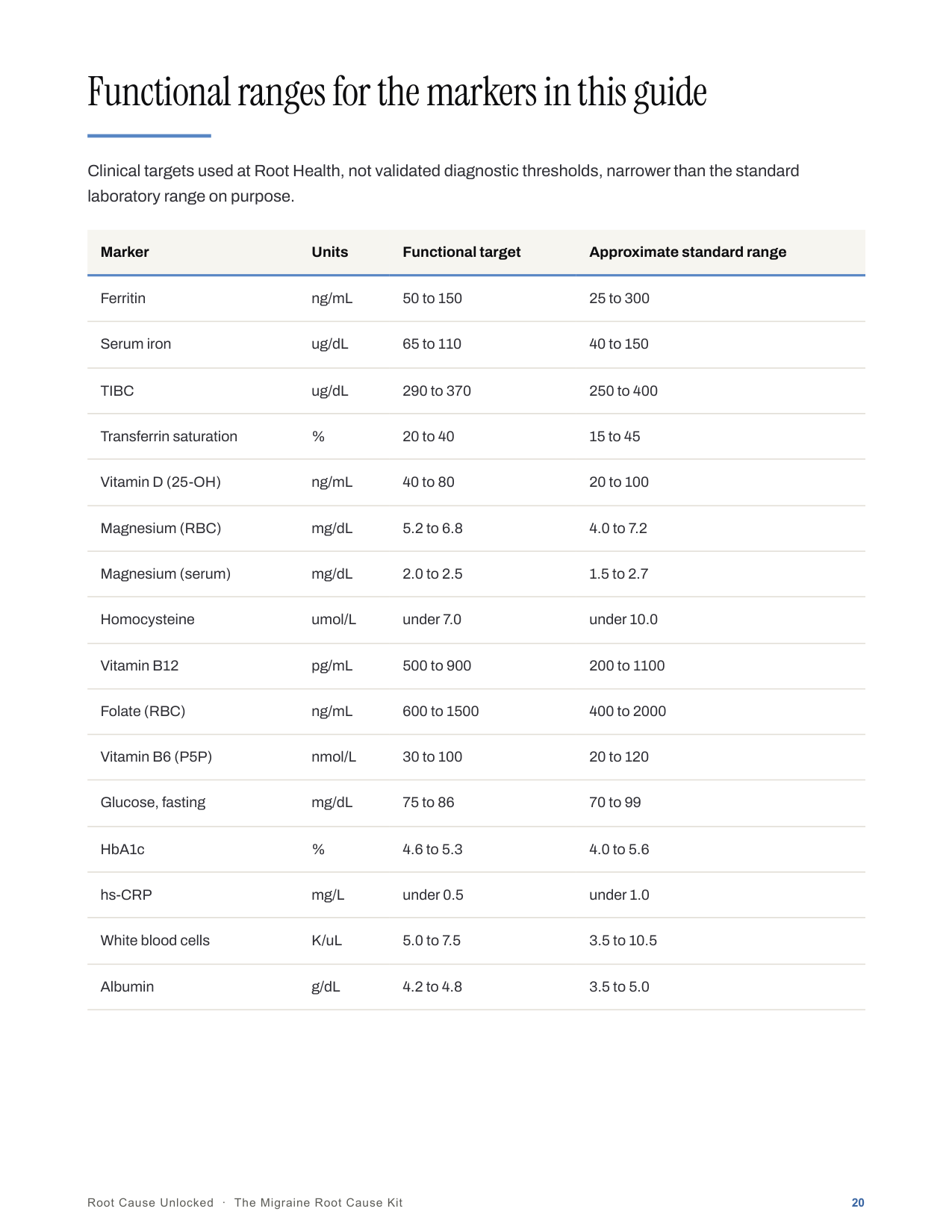
Ordering a test and knowing what to do with the result are two different things. Bring your results to your physician, or to a Discovery Session, before you act on them.