
Metabolic
Unlock Your Hormones
The panel came back normal and you still do not feel like yourself. The cycle is irregular but not a big deal, the energy is gone but that is just stress, the weight will not move no matter what you change, and the libido quietly disappeared somewhere in the last few years. None of that is a diagnosis, and all of it is information. Hormones are messengers rather than the root cause, which means the useful question is never what your level is, it is what is making it do that.
Educational and screening-oriented. Nothing here is a diagnosis.

Recognition
Does this sound like you
Hormone symptoms rarely arrive as one clean complaint. They scatter across your energy, your cycle, your skin, your sleep, and your mood, which is exactly why they get handled one at a time and never connected to each other.
- Your cycles are irregular or have gone missing, and the acne, the excess facial or body hair, and the weight that will not move have all been treated as separate complaints rather than as one pattern.
- You are a man under fifty and the drive, the muscle, and the morning energy that used to be there without effort are simply gone, and everyone around you says that is what happens after thirty-five.
- You have a regular-seeming bleed on hormonal birth control, which is a withdrawal bleed the medication itself creates, and not, on its own, evidence that the pattern underneath has resolved.
- Heavy or painful periods, breast tenderness, mood swings, and stubborn weight around the hips and thighs, alongside bowel movements that are not daily, which turns out to be more relevant to that picture than it sounds.
- Your cycles stretched out or stopped during a stretch of hard training, undereating, or sustained stress at work or at home, and nobody ever connected the two things.
- Fatigue, cold intolerance, hair thinning, and constipation that persist after you have genuinely fixed your sleep, with a single normal TSH used to close the door on thyroid as a contributor.
What actually gets looked at
The useful question is what moved the number
A hormone panel tells you what the messengers are doing. It rarely tells you why. Testosterone that is low because of excess weight, poor sleep, and untreated apnea reads exactly the same on paper as testosterone that is low for a pituitary reason, and those two need completely different responses. So the assessment goes after the driver, not just the level.
Insulin before glucose moves
If PCOS is the question, this is the highest-yield part of the workup. Fasting insulin, fasting glucose, and HbA1c belong together, because fasting glucose alone can look normal for years while insulin climbs to keep it there, and that window is exactly when something can be done. Insulin drives the pattern from two directions at once: it pushes the ovary's theca cells toward more androgen production, and it suppresses the liver's output of SHBG, which frees up the testosterone already in circulation. It is also the single test most often left off the panel.
SHBG and free androgens
Total testosterone on its own can mislead you. SHBG determines how much of that testosterone is actually free and active, and it falls with insulin resistance, so a normal total with a low SHBG can mean a high free testosterone, which is the pattern that explains the symptoms. In women, total and free testosterone with SHBG and DHEA-S belong in a complete workup, particularly when energy, libido, or muscle mass are part of the picture. Androgens matter for bone, muscle, and cognition in women, not only for reproduction, and a normal estrogen and progesterone panel does not tell the whole story.
Morning testosterone, drawn twice
Two rules get broken constantly here. Testosterone follows a daily rhythm, so an afternoon sample can read misleadingly low, and a single low reading is not a diagnosis, which is why it should be confirmed on a second, separate morning sample before anyone acts on it. If it is genuinely low, the next question is why. LH and FSH separate a testicular cause from a pituitary one, and prolactin, ferritin and iron studies, and a sleep apnea assessment belong in the same look. In men under fifty, low testosterone is far more often downstream of something addressable than a primary gland problem.
Estrogen clearance and the gut
Estrogen dominance is much more often a clearance problem than an overproduction problem, and the clearance happens in two places nobody thinks about. Your liver processes used estrogen down one pathway or another, then tags it for elimination and sends it to the bowel. Certain gut bacteria produce an enzyme that strips that tag back off, releasing already-processed estrogen into circulation instead of letting it leave. That recirculation loop is the estrobolome, and transit time and fiber are what most influence how much comes back. I read metabolite panels as information about routes rather than as targets to correct, for reasons in the next section.
Thyroid, the cross-referenced driver
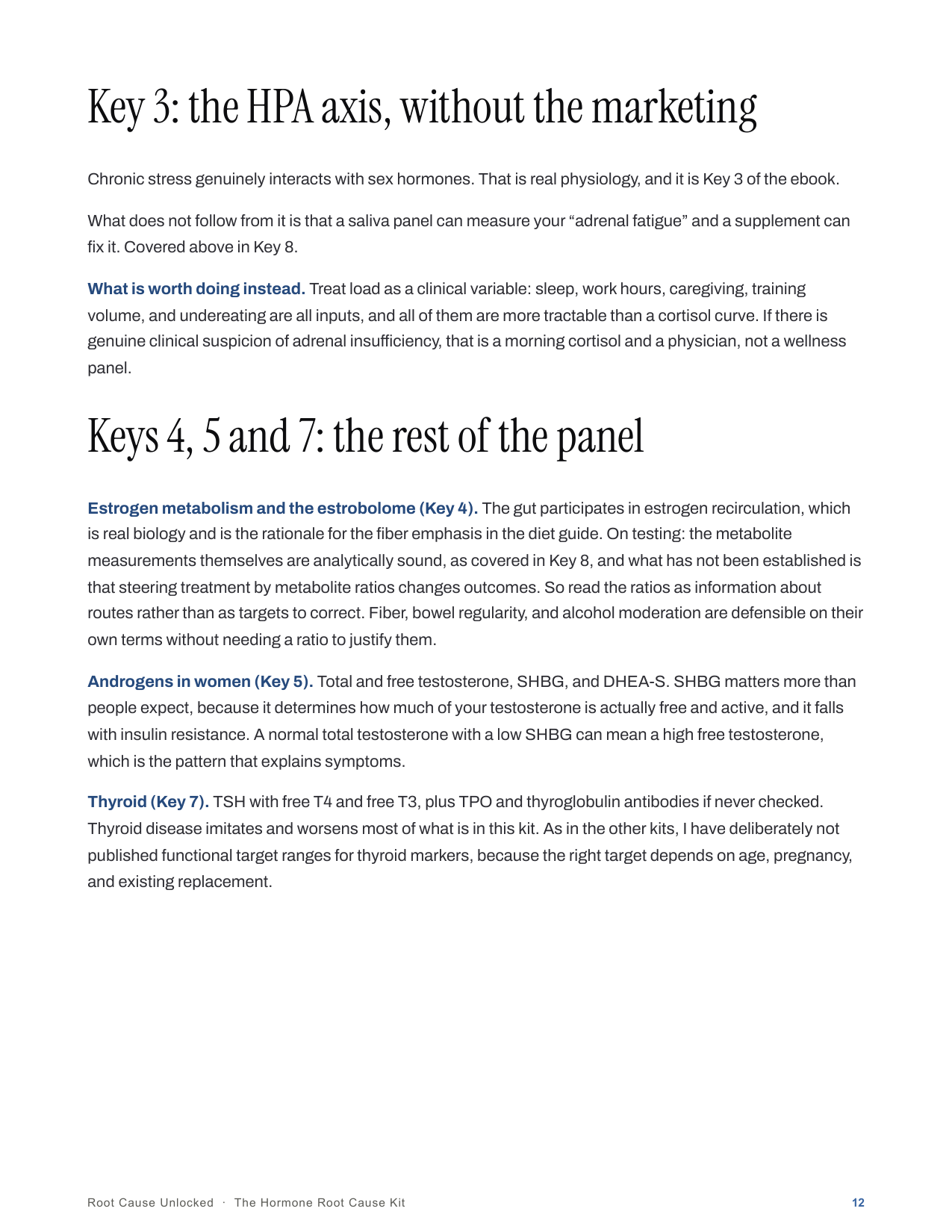
Thyroid function and sex hormone function are wired together closely enough that an unaddressed thyroid problem can look, on the surface, exactly like a primary hormonal one. Thyroid status affects the cycle directly through the ovary and indirectly through SHBG, prolactin, and GnRH signaling, which means irregular cycles, low libido, and fatigue can trace back there instead. So the panel is TSH with free T4 and free T3, plus TPO and thyroglobulin antibodies if they have never been checked. I have deliberately not published functional target ranges for these, because the right target depends on age, pregnancy, and any existing replacement.
The rest of the picture
Hormone symptoms rarely travel alone. Vitamin D, B12, ferritin, and magnesium are worth measuring, because a real shortfall is correctable and ferritin matters particularly with heavy cycles. Homocysteine is one of the most consequential numbers in the panel, because it says the methylation machinery is running short somewhere findable, and the move is to identify which input is short rather than chase the number blindly. hs-CRP tells you an inflammatory load exists somewhere and never confirms your hormones are the source. Load itself is a variable too: sleep, work hours, caregiving, training volume, and undereating are all inputs, and all of them are more tractable than a cortisol curve.
Honest limits
Accurate measurement is not the same as a diagnosis
Start with adrenal fatigue, because it is the largest oversell in this category. A systematic review that set out specifically to test whether it was a real, substantiated condition concluded there is no consistent evidence for it as a medical entity, in large part because the cortisol testing methods used to diagnose it produce conflicting results across the literature. Chronic stress genuinely interacts with your sex hormones. That physiology is real. What does not follow is that a saliva kit measures exhausted adrenals and a capsule refills them. The honest name for the real thing is HPA axis dysregulation, and it is handled as load you manage rather than as a disease you measure. Adrenal insufficiency, by contrast, is a genuine and serious diagnosis, established with morning cortisol and specialist testing rather than a wellness panel, so severe fatigue with dizziness, low blood pressure, salt craving, and darkening skin is a physician now, not a kit.
The dried urine panels are more interesting than either side of the argument usually admits, and I have changed my own position on them after reading the record. The common criticism, that they are simply unvalidated, is not accurate. Published method work shows good agreement between the dried urine and serum assays, and between a four-spot collection and a 24-hour one, so the assay measures what it claims to measure. What that does not establish is that steering treatment by those results leads to better outcomes, and I could not find studies that do. The reference ranges are the sharper caveat, and it comes from the manufacturer's own interpretive guide: the ranges are built from their internal database and set deliberately more tightly than classic diagnostic ranges so as to flag people for attention. Being outside such a range means you are in a minority of the tested population. It does not mean you have a disorder. So anchor anything involving a diagnosis or a prescription on serum, and use dried urine for what the validation actually supports, which is tracking a pattern over time and seeing routes that serum does not show.
So part of the work is subtraction. Sorting what the evidence supports from what it does not, deciding which findings mean something in your specific case, and being willing to leave things on the shelf. Inositol is the best supported supplement in this whole category, and its own umbrella review says the evidence is low quality and should not be steering clinical decisions by itself. Vitamin D is marketed hard as a testosterone lever, and the most rigorous recent meta-analysis of randomized trials found no clear effect on testosterone in men. A normal panel alongside real symptoms is a genuine result too, and it moves the work toward sleep, load, blood sugar stability, and thyroid rather than ending it. Nothing in this process asks you to stop or change a prescription, including birth control, testosterone replacement, metformin, or thyroid medication. That decision belongs to you and your prescribing clinician. And none of this is fertility treatment. If you are trying to conceive and it is not happening, that is a reproductive endocrinologist, and time matters there. I still use it where the insulin picture justifies it, held to your own baseline over a defined trial rather than to a promise, and I stop it if your markers and your symptoms do not move.
Bring a pattern, not a single number
The assessment maps your symptoms across systems in a few minutes. The discovery session is a straight conversation about what that pattern suggests, which tests would actually answer your question, and what probably does not apply to you. In this category a few cycles of honest tracking tells a practitioner more than any single panel can on its own. Consultations and ongoing care are both available wherever you are located, and being outside North Carolina is not a barrier to working with me.
Prefer to start on your own?
Take the guides with you
The same clinician-written material, as an instant download. Covers below are the actual files you receive.

The ebook
$27
Unlock Your Hormones, 21 pages
- The keys to understanding it: what is actually going on, in plain language
- The evidence and its limits, stated honestly rather than oversold
- An actionable plan to work through, and what to expect from it
The kit
$47
Three working guides, 45 pages
- Lab guide. Understanding Your Hormone Labs: which tests are worth running, and how to read what comes back
- Dietary support. The Hormone Diet Guide: what the evidence supports about eating with this condition
- Supplement support. The Hormone Supplement Guide: what has been studied, tiered by evidence, with the medication cautions that matter
The ultimate guide
$67
Everything above in one PDF, 65 pages
- The ebook and all three guides in one document, with a single contents page
- A bridge section that connects the understanding half to the doing half
- One file to keep, print, or take to an appointment
Instant download, yours to keep. Educational only; personalized care starts with a free Discovery Session.
Testing
You can order the labs yourself
If your physician will run the testing, ask them first. That is usually the cheaper route. If you would rather not wait, or you have already been told your labs are normal, many of the panels I use in practice can be ordered directly through my patient portal.
Ordering a test and knowing what to do with the result are two different things. Bring your results to your physician, or to a Discovery Session, before you act on them.