
Metabolic
Unlock Your Heart Health
Your cholesterol panel came back with a flag on it. Your blood pressure has been creeping up across the last few checkups, and someone handed you a pamphlet about salt. A scan done for something else mentioned a fatty liver almost in passing, and nobody explained why it was there. What usually does not happen in a fifteen minute visit is anyone sitting down and showing you that in a large share of people those are not three problems, they are one problem showing up in three places.
Educational and screening-oriented. Nothing here is a diagnosis.

Recognition
Does this sound like you
These numbers get treated as three separate conversations, sometimes with three separate specialists, each with its own guideline and its own drug. The pattern across them usually tells you more than any single line on the printout.
- A red flag next to LDL on your panel, and the entire explanation you were given was to watch your diet and recheck it later.
- Blood pressure drifting upward across your last few visits, with cutting salt offered as the whole answer, which you did, and it moved very little.
- A fatty liver mentioned almost in passing on an ultrasound or a CT done for something else, with no explanation of what it meant or why it was there.
- Three numbers, three appointments, sometimes three different specialists, and nobody has drawn the line connecting them for you.
- Muscle aches that started after the statin, and every conversation about it has run in one direction, either stop the drug or stop complaining about it.
- Your waist has expanded even though the scale has barely moved, and you snore or wake up unrefreshed, and neither of those has been connected to your numbers.
What actually gets looked at
Test the engine, not only the gauges
Cholesterol, blood pressure, and liver fat tend to move together because they share an upstream driver, so the assessment goes after that driver as well as the three numbers it produces. Three of the nine things I look at are not blood tests at all, and one of them is a tape measure.
Insulin, the shared root
Glucose stays normal for years while insulin climbs to hold it there, so a workup built on glucose alone finds the problem only after that compensation has begun to fail. I ask for fasting insulin alongside fasting glucose and HbA1c, and I calculate the triglyceride to HDL ratio, which requires no additional test and can be read off a panel you probably already have. That ratio is a pointer toward the insulin resistant pattern rather than a validated diagnostic threshold, so it belongs in your appointment as a question rather than a conclusion. If that engine is what is driving your picture, one set of changes moves all three numbers instead of three separate plans.
Particle count, not cargo
Every atherogenic particle carries exactly one apolipoprotein B molecule, so ApoB counts the particles while LDL cholesterol measures the cholesterol carried inside them. Those two come apart in a specific group: people with diabetes, obesity or metabolic syndrome, raised triglycerides, or a very low LDL. That is precisely the population the insulin chapter is about, which means an LDL that reads as reassuring can sit on top of a particle count that does not. So I ask for ApoB, and where a lab does not offer it, non-HDL cholesterol, which is total cholesterol minus HDL and can be calculated from the panel already in your chart.
Lipoprotein(a), measured once
Lp(a) is largely inherited, barely moves with diet or lifestyle, and does not come down with a statin, because statins work through a different pathway. It is an independent risk factor for atherosclerotic cardiovascular disease and for calcific aortic stenosis, and it is measured on request rather than as part of a standard panel. Once in your life is usually enough. A high result is not a lifestyle failure. It means your baseline sits higher, that everything you can control matters more, and that first degree relatives are worth testing too, which makes this one of the few numbers here with family implications.
Inflammation, read carefully
hs-CRP is the high sensitivity assay, not standard CRP. Standard CRP is built to detect infection level inflammation, while the high sensitivity version reads the low range that matters for the blood vessel lining. It is a nonspecific screening marker, which means it tells you an inflammatory load exists somewhere without telling you where it comes from, and a recent cold, an injury, a flaring joint, or a dental problem will all raise it. So a single raised result changes nothing on its own. I repeat it when you are well before reading anything into it, and I would rather order it alongside the lipid work than piecemeal.
The liver, a metabolic organ
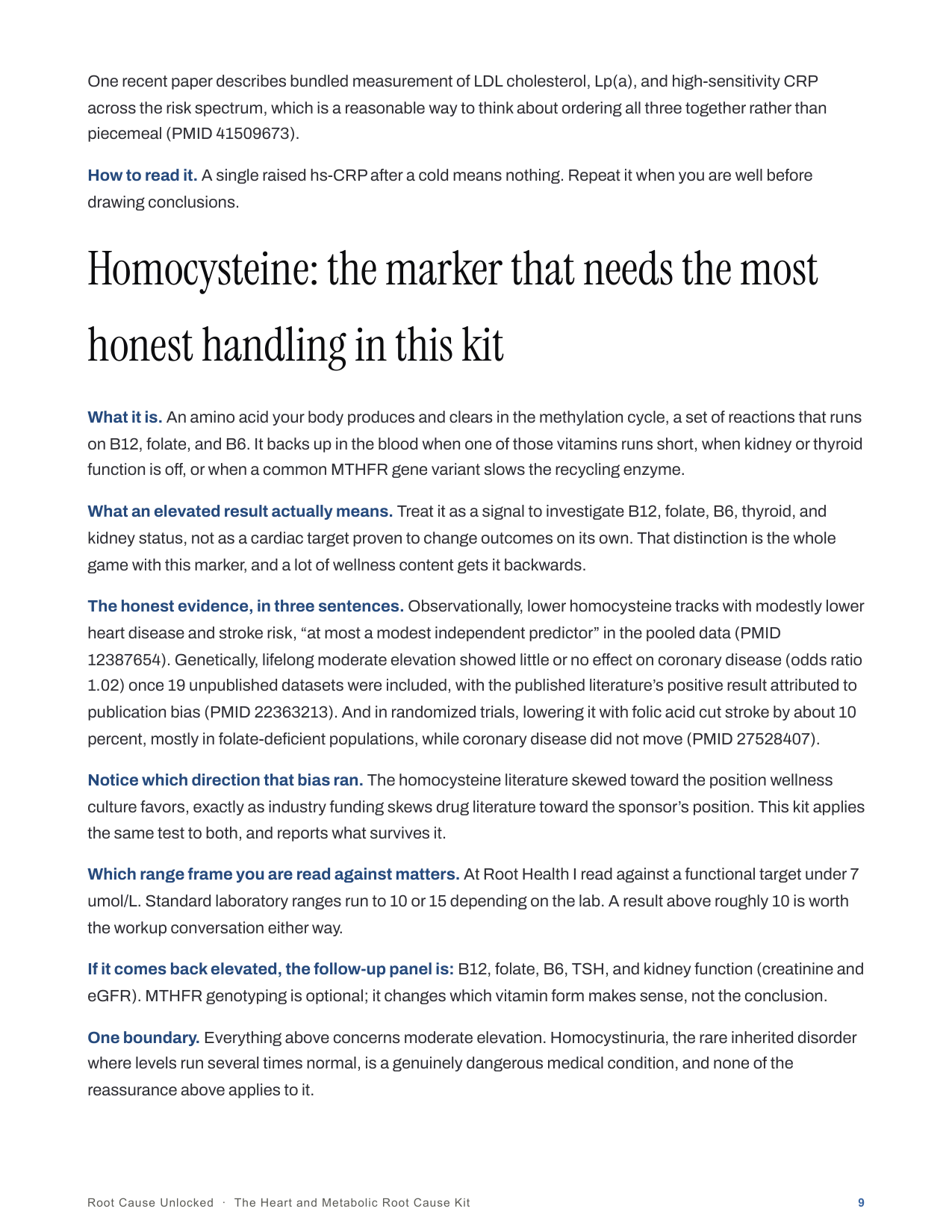
Fatty liver is now usually called metabolic dysfunction associated steatotic liver disease, and the name change is the point: this is a metabolic condition, not primarily an alcohol story. ALT, AST, and GGT are the routine place to start, and the most common misunderstanding here is that a normal ALT rules fatty liver out. It does not. Where there is suspicion, imaging and a non-invasive fibrosis score are the next step, and that is a physician's call rather than mine. A fatty liver finding is worth taking as seriously as an abnormal lipid panel, not filing as a footnote.
The tests without a lab
Three of the nine keys are not blood work. A validated upper arm home monitor, read morning and evening across a week, tells you far more than a single reading taken in an exam room, and most home readings are taken wrong, so technique is part of the instruction. A tape measure at the level of the navel tracks visceral fat, and over a year it is a better progress signal than the scale, because it moves when body composition changes even when weight does not. And if you snore or wake unrefreshed, a sleep apnea assessment belongs in this workup.
Honest limits
What is settled here, and what is not
The part that is not seriously contested is LDL's causal role in atherosclerotic disease, and that if you have already had a heart attack, a stroke, or a stent or bypass, the case for staying on your statin is strong. What is genuinely contested is the size of the benefit for someone who has had none of that and is being treated on estimated risk. A meta-analysis restricted to that truly primary prevention population found that lipid lowering therapy reduced nonfatal cardiovascular events and hospitalizations without a demonstrated reduction in all cause or cardiovascular mortality. That is a real benefit, and it is a materially smaller claim than most people are handed. The practical move is not to argue the point. It is to get your risk calculated with a validated calculator using your actual numbers, to ask your prescriber which of the two prevention categories you are in, and to ask for absolute figures rather than relative ones.
The funding problem runs in both directions, and I hold both to one standard. Industry sponsored drug research produces results more favorable to the sponsor, and a Cochrane methodology review concluded that this bias is not caught by the usual quality checks, so a well conducted randomized trial is not an answer to the question of who paid for it. The homocysteine literature skewed the opposite way, toward the position wellness culture prefers, until a genetic analysis that deliberately gathered unpublished datasets found little or no effect on coronary disease. That is why I read an elevated homocysteine as a reason to investigate B12, folate, B6, thyroid, and kidney status rather than as a cardiac number to chase. The same discipline lands hard on the popular products. Red yeast rice lowers LDL substantially because it contains monacolin K, which is chemically identical to a prescription statin, at a dose that varies between products and without the monitoring a prescription carries. The cardiovascular outcome benefit in the omega-3 literature belongs to a purified high dose prescription form in a specific population, and it did not transfer to the combined capsule on the shelf. And DASH, the most recommended eating pattern for blood pressure, came out of its most recent head to head comparison with low certainty of evidence and substantial heterogeneity, which does not mean abandon it. It means adherence matters more than which structured pattern you choose, so pick the one you will actually eat.
So part of the work is subtraction. Sorting what the evidence actually supports from what it does not, deciding which of these numbers is meaningful in your specific case, and being willing to conclude that insulin resistance is not the main driver in your picture. That is a real outcome and a useful one, because familial hypercholesterolemia and a high Lp(a) raise particle driven risk in people who are lean and insulin sensitive, and no amount of metabolic work removes them, which is exactly why they get measured. Nothing in this process asks you to stop, skip, or reduce a prescription. That decision belongs to you and your prescribing clinician. And none of it applies in an emergency: chest pain or pressure, sudden one sided weakness or trouble speaking, sudden severe breathlessness, or a tearing pain in the chest or back means calling 911, not reading.
Start with the whole picture, not one line of it
The assessment maps your history and symptoms across systems in a few minutes. The discovery session is a straight conversation about what that pattern suggests, which numbers are worth asking your physician for, and what probably does not apply to you. Consultations and ongoing care are available wherever you are located, and being outside North Carolina is not a barrier to working with me.
Prefer to start on your own?
Take the guides with you
The same clinician-written material, as an instant download. Covers below are the actual files you receive.

The ebook
$27
Unlock Your Heart Health, 24 pages
- The keys to understanding it: what is actually going on, in plain language
- The evidence and its limits, stated honestly rather than oversold
- An actionable plan to work through, and what to expect from it
The kit
$47
Three working guides, 46 pages
- Lab guide. Understanding Your Heart and Metabolic Labs: which tests are worth running, and how to read what comes back
- Dietary support. The Heart and Metabolic Diet Guide: what the evidence supports about eating with this condition
- Supplement support. The Heart and Metabolic Supplement Guide: what has been studied, tiered by evidence, with the medication cautions that matter

The ultimate guide
$67
Everything above in one PDF, 66 pages
- The ebook and all three guides in one document, with a single contents page
- A bridge section that connects the understanding half to the doing half
- One file to keep, print, or take to an appointment
Instant download, yours to keep. Educational only; personalized care starts with a free Discovery Session.
Testing
You can order the labs yourself
If your physician will run the testing, ask them first. That is usually the cheaper route. If you would rather not wait, or you have already been told your labs are normal, many of the panels I use in practice can be ordered directly through my patient portal.
Ordering a test and knowing what to do with the result are two different things. Bring your results to your physician, or to a Discovery Session, before you act on them.