
Environmental
Unlock Your Detox Capacity
You asked about heavy metals, plastics, or the forever chemicals in your water, and you got two answers that were both unsatisfying. One was a shrug. The other was a challenge test and a thirty day protocol, offered with a confidence the research does not actually have. There is an honest position between those two, and it starts by finding out where your exposure genuinely comes from before anyone builds a plan for clearing it.
Educational and screening-oriented. Nothing here is a diagnosis.

Recognition
Does this sound like you
Toxic burden is a spectrum and a hypothesis, not a yes or no answer. The useful question was never whether you are toxic. It is where your exposure actually comes from, and what would change if you knew.
- You asked a doctor about heavy metals or toxins and got a shrug, then asked the internet and got a challenge test and a cleanse. Neither answer engaged with the question you were actually asking.
- Fatigue, brain fog, or joint pain that has outlasted its workup, and toxins became the leading candidate mostly because it was the last candidate left standing.
- Your work or your hobby has a real exposure route running through it: auto body, printing, dry cleaning, nail services, agriculture, metal work, soldering, stained glass, pottery glazes, or solvent-based art supplies. No one has ever asked you about it in an exam room.
- You live in a home built before 1978, or you sanded and demolished your way through a renovation, or your water comes from a private well that has never been tested for arsenic or lead, because testing a well is on you and nobody mentioned it.
- You already had a provoked or challenge test done, got back a page of alarming numbers with a protocol attached, and were never told those numbers had been compared against reference ranges built a completely different way.
- You have tried a cleanse, a juice fast, or a detox tea and felt worse partway through, or cut oxalates and fish and half your vegetables on the strength of something you read, without ever knowing whether any of it applied to you.
What actually gets looked at
The most important item here is not a blood test
Toxic burden is a hypothesis to test, not a diagnosis to assume, and the order of operations does most of the work. The audit comes before the panel, the specimen has to match the exposure you actually have, and one commonly offered test earns a polite refusal.
The exposure audit, first
The most important item in this entire workup is not a blood test at all, and it is the exposure audit. Before any panel, I want the real picture: your water source and whether it has ever been tested, which fish you eat and how often, the year your home was built and any sanding or demolition since, your occupation and your hobbies, and what changed around the time symptoms started. No blood test replaces that history. It requires no laboratory at all, and it usually explains more than the panel that follows it.
Unprovoked, never provoked
This single decision outranks any individual result. Unprovoked testing measures blood or urine collected under normal conditions and reads it against reference ranges built the same way, which is the approach used in clinical toxicology. Provoked or challenge testing gives a chelating drug first, then compares the result against those same unprovoked ranges, which is not a fair comparison. When it was checked prospectively in patients referred for toxicology evaluation, a positive provoked result carried a positive predictive value of about 4 percent. I want you to decline that test, in exactly those words.
Metals, matched to the specimen
Lead is a blood test, and the number worth knowing is the CDC blood lead reference value of 3.5 micrograms per deciliter, which is a prompt to find and remove the source rather than a treatment threshold. Mercury splits by route: blood reads the fish exposure most people have, urine reads the occupational and dental amalgam forms. Arsenic needs speciation, or several seafood free days beforehand, because harmless seafood compounds inflate a total urine result. Cadmium reads recent exposure in blood and cumulative burden in urine. Testing the wrong compartment is how an ordinary person gets an alarming number.
PFAS, recently askable
Forever chemicals persist in the body for years, which is precisely what makes a serum panel informative: it integrates a long exposure history rather than yesterday afternoon. National Academies guidance issued in 2022 recommends that clinicians offer testing to people with likely elevated exposure, such as a contaminated water system, certain occupations, or a community near a known source, and it sorts follow up into tiers by the summed blood level. What a result changes is mostly the exposure hunt, since no approved medication removes PFAS. That points the work straight back at water, packaging, and the job.
The panel you already have
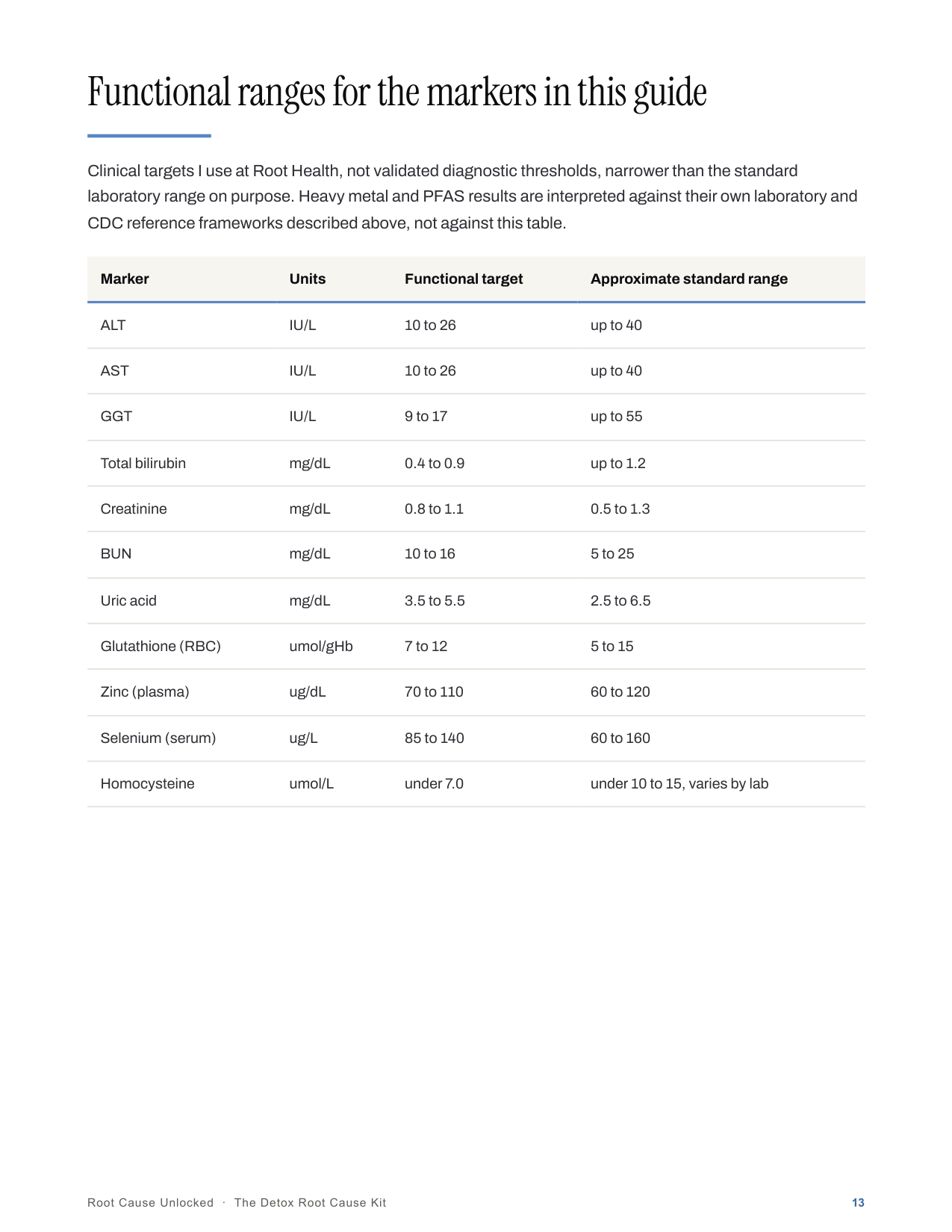
Your standard chemistry panel already reads on the two organs doing most of the elimination work, and almost nobody reads it that way. ALT and AST are the basic liver markers, and ALT is the more liver specific of the two. GGT is the one I watch closest in this territory, because it is the most sensitive routine hepatic marker for oxidative stress and its half life of two to three weeks reflects the recent past rather than this morning. Bilirubin matters because bile is a primary exit. Creatinine, BUN, and eGFR read the kidney, the other exit, and they change what is safe to take at all.
Capacity, not only burden
Burden is half the question. The other half is whether the pathways have the raw material to run at all. RBC glutathione reflects the intracellular status that plasma glutathione is far too transient to capture, and glutathione is the master Phase II conjugate, depleted fastest under oxidative load. Zinc and selenium are cofactors across the same antioxidant and conjugation systems, with two honest caveats: do not draw zinc while you are ill, because it redistributes to the liver, and selenium has a genuinely narrow window. Low capacity markers are the most actionable pattern in this whole territory.
Honest limits
What is established here, and what runs ahead of the evidence
Some of this is solidly documented. Industrial chemical exposure is close to universal in modern life, plastic particles have been directly measured and quantified in the blood of healthy adults with no unusual exposure, and there is no known safe blood lead level in a child. What does not follow is that a detectable level is a dangerous level, or that toxic burden explains a symptom simply because nothing else has. Used honestly, the term means a measurable cumulative load worth investigating. Used loosely, it becomes a catch-all with a test and a product already attached to it.
The oversold list is specific, so here it is. Provoked or challenge testing is recommended against by professional toxicology organizations, and when it was finally checked prospectively it performed close to uselessly. The broader oxalate toxicity syndrome is a community hypothesis rather than an established diagnosis, and oxalate dumping is a term from patient discussion that a direct search of the published literature does not support. Chlorella, cilantro, and the rest of the gentle binder shelf have essentially no controlled human evidence for reducing body burden. Sauna and sweating rest on one small monitoring study, and PFAS do not leave through sweat at all. The aisle that promises to fix all of this has a liver problem of its own: herbal and dietary supplements account for roughly 20 percent of drug-induced liver injury in the United States, with concentrated green tea extract and multi-ingredient blends among the leading implicated agents. That gap is real, and it is not a reason to do nothing. It is a reason to say plainly which tools I actually use, in what order, and what the evidence behind each one honestly is.
The exposure audit comes first, always. Finding and removing the source is the one intervention the toxicology literature supports without argument, it is the only thing that touches PFAS at all, and it costs nothing, which may be why nobody markets it. Sauna comes second, and the evidence picture is exactly what I said above: some metals and some chemicals are measurable in sweat, that finding comes from one small monitoring study, no trial has shown that sweating lowers body burden or improves how people feel, and PFAS do not leave through sweat. I use sauna in my practice anyway, because sweating is a route the body already runs and because of what I have observed clinically, and I am labeling that as observation rather than proof. Binders come last, and in my practice they are gated rather than default. The binder shelf is the same one I just told you has essentially no controlled human evidence for reducing body burden, and that does not change because I use it. A binder earns a place in your plan only when two things are true: your bowels are moving regularly, because a binder cannot escort anything out of a gut that is not emptying, and there is a documented exposure to aim it at, from the audit or from unprovoked testing, rather than a hunch. When I do use one, it is taken 1 to 2 hours away from food, supplements, and medication. That is clinical practice, stated as clinical practice.
What I actually use for drainage support is the Energetix line, matched to how longstanding the picture is: Lymph-Tone I where things are acute, Lymph-Tone II for matrix level and most chronic pictures, Lymph-Tone III where it is deep or longstanding, and ReHydration for electrolytes and cellular hydration. I keep a screened dispensary through Fullscript, which ships directly to you, so where you live does not decide whether you can get them, and I ask you to take them per label direction rather than to a number I carried over from somewhere else. Two honest notes belong with that. These are homeopathic preparations, and the research base does not support them by the standard I have been applying all the way down this page. I use them because of what I have observed in my own practice, which is clinical observation rather than trial evidence, they cost little and carry little risk, and which one fits you is individual enough that it belongs in a conversation. Root Health earns a portion of dispensary purchases.
So a real part of this work is subtraction. The most common outcome of honest testing is that everything comes back normal while your symptoms stay entirely real, and that is a finding rather than a dead end: it means toxins is not the supported explanation, and the honest next move is to go look where the evidence actually points instead. When something genuinely does turn up on unprovoked testing, it goes to your physician, with source hunting from the audit running alongside it. Some situations skip all of this from the start. Suspected acute poisoning, a child with plausible lead exposure, or any exposure concern during pregnancy or breastfeeding belongs with a physician or Poison Control at (800) 222-1222 right away, not with a guide. Nothing in this process asks you to stop or change a prescription. That decision belongs to you and your prescribing clinician.
Start with the audit, not the panel
The assessment maps your symptoms and your exposure history in a few minutes. The discovery session is a straight conversation about which of those exposures is worth investigating, what testing would genuinely tell you, and what probably does not apply to you at all. Consultations and ongoing care are both available wherever you are located, and being outside North Carolina is not a barrier to working with me.
Prefer to start on your own?
Take the guides with you
The same clinician-written material, as an instant download. Covers below are the actual files you receive.
The ebook
$27
Unlock Your Detox Capacity, 19 pages
- The keys to understanding it: what is actually going on, in plain language
- The evidence and its limits, stated honestly rather than oversold
- An actionable plan to work through, and what to expect from it
The kit
$47
Three working guides, 53 pages
- Lab guide. Understanding Your Toxin and Detox Labs: which tests are worth running, and how to read what comes back
- Dietary support. The Detox Diet Guide: what the evidence supports about eating with this condition
- Supplement support. The Detox Supplement Guide: what has been studied, tiered by evidence, with the medication cautions that matter
The ultimate guide
$67
Everything above in one PDF, 70 pages
- The ebook and all three guides in one document, with a single contents page
- A bridge section that connects the understanding half to the doing half
- One file to keep, print, or take to an appointment
Instant download, yours to keep. Educational only; personalized care starts with a free Discovery Session.
Testing
You can order the labs yourself
If your physician will run the testing, ask them first. That is usually the cheaper route. If you would rather not wait, or you have already been told your labs are normal, many of the panels I use in practice can be ordered directly through my patient portal.
Ordering a test and knowing what to do with the result are two different things. Bring your results to your physician, or to a Discovery Session, before you act on them.