
Neurological
Unlock Your Brain Health
You walk into a room and forget why you came in. A word you have used your whole life sits just out of reach, and you read the same paragraph three times without holding any of it. Underneath the fog, or sometimes instead of it, there is a low mood or a hum of anxiety that a good night of sleep does not lift. Brain fog and low mood are signals with causes, and a surprising number of those causes are common, testable, and genuinely correctable.
Educational and screening-oriented. Nothing here is a diagnosis.

Recognition
Does this sound like you
Standard bloodwork screens for a narrow set of conditions and stops there, and a fifteen-minute visit rarely has room for the layered questioning these symptoms actually require. Some people arrive because of the fog, some because of the mood, and many because of both at once.
- You have been told your labs are normal, or that this is probably stress, aging, or a busy season of life, and the explanation has never quite matched how different your thinking feels from the inside.
- Meetings and conversations you used to follow without effort now take deliberate work, and the word you want arrives a beat too late in front of people whose opinion matters to you.
- The fog is heaviest late in the morning after a bread-and-coffee breakfast and noticeably steadier on the days you eat regular balanced meals, a pattern nobody has ever connected to your head.
- You snore, wake up gasping, or log a full night and still get up unrefreshed, and it has been treated as a sleep habit to fix rather than something worth formally evaluating.
- Bloating, irregular bowels, reflux, or newer food reactions travel alongside the fog and the mood, handled by different people who have never compared notes with each other.
- Your medicine cabinet has grown over the years, allergy pills, a sleep aid, a bladder medication, and no one has ever added up what the whole list together does to your thinking.
What actually gets looked at
The treatable causes come first, and three of them are not blood tests
Brain fog and low mood are two of the least specific symptoms in medicine, which is exactly why they get waved off. So the workup is deliberately the opposite of a shotgun panel. It starts with the things that are common, testable, and correctable, because finding one true item on that list is worth more than months of supplements aimed at a problem that was never the driver.
The B12 test that misses B12
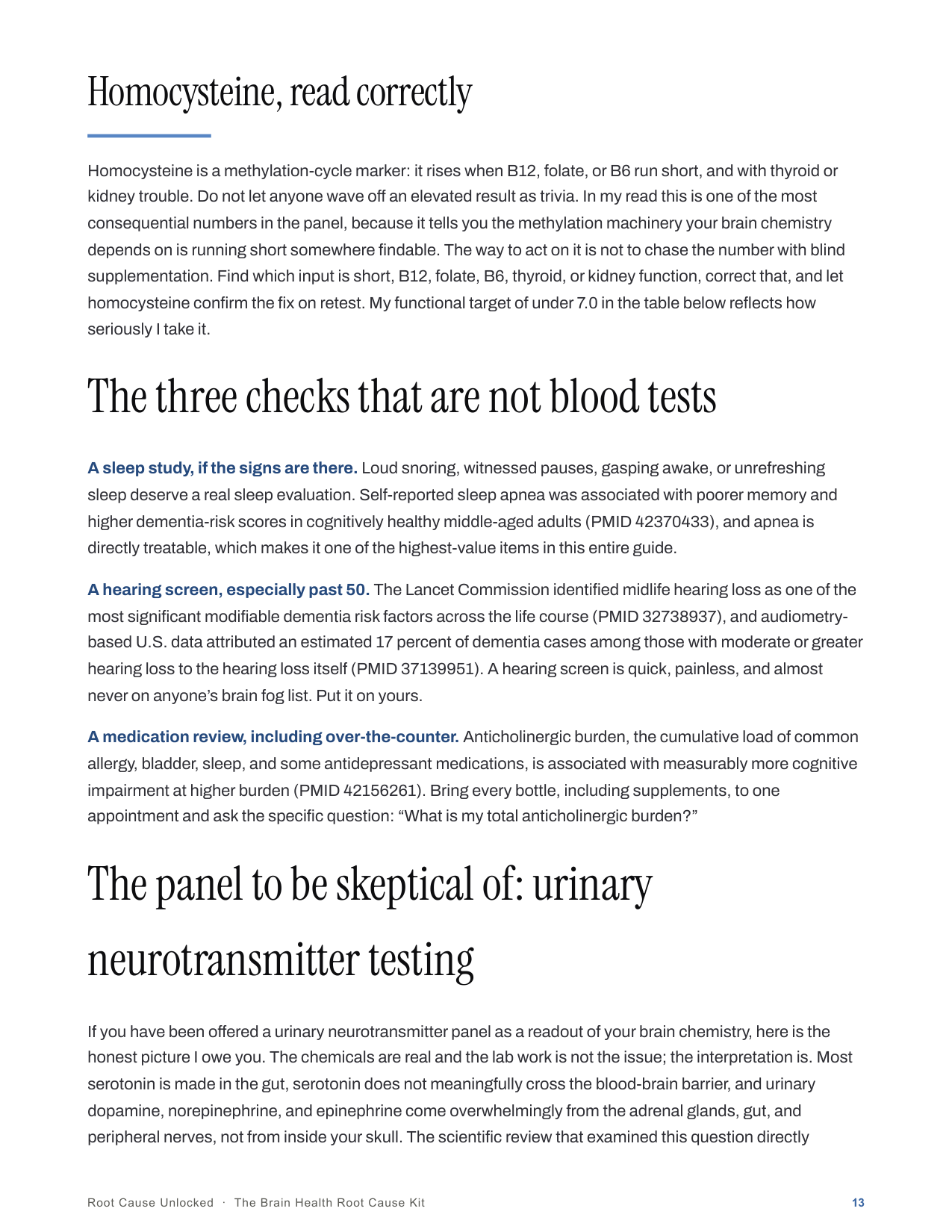
Serum B12 does not always reflect what your cells are actually getting, which is how a real deficiency gets waved through on a single number. Methylmalonic acid is the most sensitive functional marker of B12 status, so a low-normal B12 sitting next to an elevated MMA reads very differently than the B12 did alone. One caution from my own interpretive framework: MMA also rises when kidney function is impaired, so I read it alongside creatinine. This matters because correcting a measured deficiency is a different job, and a far more satisfying one, than supplementing on a hunch.
Folate, and the methylation number
Ask for red blood cell folate rather than serum, because it reflects roughly three months of tissue status instead of this week's meals. Note the shape of the national folate analysis in U.S. women: both the lowest and the highest levels carried higher odds of depression than the middle did. Sufficiency, not maximizing a number. Homocysteine is the marker I take most seriously here, because when it climbs it says the methylation machinery your brain chemistry depends on is running short somewhere findable: B12, folate, B6, thyroid, or kidney function. Find the short input, correct it, and let the retest confirm the fix.
Thyroid, with both halves
Hypothyroid brain fog is a real, recognized clinical experience: fatigue, low mood, and executive-function trouble that often precedes the diagnosis. The honest other half is that an analysis pooling individual data from more than 74,000 adults found subclinical thyroid dysfunction was not associated with measurable cognitive differences at the population level. Both are true at once. A TSH and free T4 are simple and widely available, and correcting a genuinely abnormal result is worthwhile on its own terms. I publish no thyroid reference table anywhere in this program, because targets vary enough by age, sex, and treatment status that the conversation belongs with your clinician over your actual numbers.
Fuel stability and inflammation
Fasting glucose, HbA1c, and fasting insulin read the fuel story together, and the brain notices insulin resistance years before anyone would call it diabetes. Fog that is worse after meals, or better on the days you eat regularly, is a pattern worth naming out loud at the appointment rather than leaving for the lab to find. hs-CRP is the routine rough read on systemic inflammation, which has documented links to mood symptoms in a meaningful subset of people. It tells you a load exists, not where it is coming from, so it opens a question. A single high reading after an illness means little; repeat it when you are well.
Oxygen delivery, iron, vitamin D
Low hemoglobin means less oxygen reaching the brain, and the cognitive association is measurable well above the levels most people think of as dangerously low, with a larger effect in older adults. A complete blood count plus ferritin catches most of it. Ferritin is also an acute-phase reactant, so I read it next to hs-CRP: a normal-looking ferritin during inflammation can hide depleted iron. Vitamin D belongs on the same draw. It has been linked to depressive symptoms, and the honest grade from the review literature is that supplementation trials for mood are inconsistent, so it is worth checking and correcting if low, not guaranteed to fix anything.
The three without a needle
Three of the highest-value checks in this entire workup are not blood draws at all. A sleep study, if you snore, wake gasping, or never feel refreshed, because self-reported apnea has been associated with poorer memory in cognitively healthy middle-aged adults and because apnea is directly treatable. A hearing screen, especially past fifty or after years of noise exposure, because the Lancet Commission put midlife hearing loss among the most significant modifiable risk factors across the life course. And a medication review, every bottle on the table, asking one specific question: what is my total anticholinergic burden?
Honest limits
Parts of this field are sold with far more certainty than they have earned
If you have been offered a urinary neurotransmitter panel as a readout of your brain chemistry, here is the picture I owe you. The chemicals are real and the lab work is not the issue. The interpretation is. Most of your serotonin is made in your gut, serotonin does not meaningfully cross the blood-brain barrier, and the dopamine, norepinephrine, and epinephrine measured in urine come overwhelmingly from the adrenal glands, the gut, and peripheral nerves rather than from inside your skull. The scientific review that examined this question directly concluded that the established clinical use of such testing is detecting a rare adrenal tumor, and that the evidence connecting urinary levels to mood or attention was early and limited. That is one data point collected outside your brain. It should never be handed to you as a brain-chemistry readout, and it should never be the sole basis for a plan.
The same discipline runs in the other direction. The gut-brain axis is genuinely interesting science and it is also routinely oversold as a settled explanation for one person's symptoms, so the defensible version stays modest: if gut symptoms travel alongside your fog, say so specifically and let that steer the workup rather than replace it. Ginkgo biloba, the most widely sold memory herb, got the large, publicly funded, placebo-controlled trial its popularity earned, followed older adults for years, and did not reduce the incidence of dementia or Alzheimer's disease. Multi-ingredient nootropic blends are essentially never tested as combinations and routinely underdose the one ingredient with any evidence behind it. And "type 3 diabetes" is a nickname for a real line of insulin-signaling research, not a diagnosis anyone can give you and not a warrant for the protocol usually sold on the strength of the phrase.
So part of the work here is subtraction. Sorting the findings that actually explain your symptoms from the ones that merely exist on a page, and being willing to land somewhere unglamorous: an apnea evaluation, one real deficiency corrected, a medication list reviewed with your prescriber, the plate and the movement habit built before anything gets layered on top. That is a real outcome and a good one. Everything here is designed to run alongside psychiatric and mental health care, never instead of it. Nothing in this process asks you to stop, reduce, or skip a prescription, because that decision belongs to you and the clinician who prescribed it. And if you are in crisis right now, call or text 988. Nothing in any lab panel matters more than that call.
Start with what is actually correctable
The assessment maps your symptoms across systems in a few minutes. The discovery session is a straight conversation about which of the treatable causes have genuinely been checked rather than assumed normal, which ones are worth checking next, and what probably does not apply to you at all. If you would rather begin on your own, two weeks of honest tracking makes any later appointment, with me or with your own physician, far more useful than memory alone. Consultations and ongoing care are both available wherever you are located, and being outside North Carolina is not a barrier to working with me.
Prefer to start on your own?
Take the guides with you
The same clinician-written material, as an instant download. Covers below are the actual files you receive.
The ebook
$27
Unlock Your Brain Health, 32 pages
- The keys to understanding it: what is actually going on, in plain language
- The evidence and its limits, stated honestly rather than oversold
- An actionable plan to work through, and what to expect from it
The kit
$47
Three working guides, 37 pages
- Lab guide. Understanding Your Brain Fog and Mood Labs: which tests are worth running, and how to read what comes back
- Dietary support. The Brain Health Diet Guide: what the evidence supports about eating with this condition
- Supplement support. The Brain Health Supplement Guide: what has been studied, tiered by evidence, with the medication cautions that matter
The ultimate guide
$67
Everything above in one PDF, 67 pages
- The ebook and all three guides in one document, with a single contents page
- A bridge section that connects the understanding half to the doing half
- One file to keep, print, or take to an appointment
Instant download, yours to keep. Educational only; personalized care starts with a free Discovery Session.
Testing
You can order the labs yourself
If your physician will run the testing, ask them first. That is usually the cheaper route. If you would rather not wait, or you have already been told your labs are normal, many of the panels I use in practice can be ordered directly through my patient portal.
Ordering a test and knowing what to do with the result are two different things. Bring your results to your physician, or to a Discovery Session, before you act on them.