
Immune and histamine
Unlock Your Allergies
You have been managing this for years rather than answering it. An antihistamine in the morning, a nasal spray somewhere in the afternoon, and a steady low grade misery that nobody around you quite registers, because from the outside it looks like a runny nose. What rarely gets asked is why your immune system became this reactive in the first place, or whether the thing you have been avoiding is the thing that is actually bothering you. Allergy is unusual in this field, because those questions have real answers and real tests behind them.
Educational and screening-oriented. Nothing here is a diagnosis.

Recognition
Does this sound like you
Allergy is really several different situations wearing the same clothes, and which one you are in decides almost everything that follows. The pattern in how and when you react usually tells you more than a panel does.
- Every year, the same weeks. Sneezing, itchy eyes, and congestion that arrive on schedule and only partly answer to an over the counter antihistamine.
- A broad panel came back with a long list of foods, you removed all of them, and the list has quietly grown since. Nothing has ever been put back.
- Raw apple, cherry, melon, or celery makes your mouth and throat itch within minutes, and the same food cooked, peeled, or canned does nothing at all.
- Your worst days follow what has been sitting: aged cheese, wine, cured meat, a container of leftovers on day three. Flushing, headache, congestion, a racing heart.
- Your reactions are real and reproducible, every allergy test came back negative, and you were either told it was unexplained or handed a label without a tryptase ever being drawn during an actual episode.
- A fatigue that everyone files under allergies or under the antihistamine, when nobody has checked your ferritin or your vitamin D.
What actually gets looked at
The history decides the test, not the other way around
Allergy is the rare area where validated tests exist, and they were validated against controlled food and allergen challenges. That is genuinely good news, with a catch: the tests marketed hardest to allergy sufferers online are mostly not those tests. So the order stays fixed. The story first, then a test chosen to confirm or refute that specific story, then a result read against how likely the story was to begin with.
Sensitization is not allergy
A positive skin prick or blood IgE result tells you your immune system has made antibodies to something. It does not tell you that you react to it. Real allergy is both halves together, a positive test and consistent symptoms on actual exposure, and neither half is an answer alone. That is why a broad panel ordered without a history is a trap. Test forty allergens in someone with no story and you will find positives, and those positives then get treated as instructions. The test did not lie. It was asked the wrong question.
The tests that are validated for this
Skin prick testing and serum specific IgE are the two that do this job. A bigger wheal means more IgE bound, not a more severe reaction coming, and people are told the opposite constantly. Blood testing is the better choice when you cannot stop antihistamines for several days, when a reaction has been severe, or when you want a number to follow over time. If your reactions are limited to raw fruit and vegetables, component testing is worth asking about by name. For food, the reference standard is a supervised oral food challenge, and the blood and skin tests largely exist to decide who needs one.
How you clear histamine
Two enzymes do this. DAO works in the gut lining on the histamine you eat, and its activity depends on vitamin B6, copper, and vitamin C. HNMT works inside cells and runs on a methyl donor, which is why B12, folate, and homocysteine belong on the same draw. I ask for serum DAO activity at baseline, before anything about the diet changes, alongside those cofactors, so that a low result can be read against a correctable shortfall rather than guessed at. One instruction follows directly from the research: DAO is a baseline measure, not a progress measure. Judge the diet by your symptoms instead.
The load underneath
Food reactivity, a compromised gut barrier, dysbiosis, and toxic burden stack up under the same immune threshold, and any one of them can be what pushes you over it. A food specific IgG panel is a starting map for a structured elimination, not a diagnosis, and it cannot rule an IgE allergy in or out. The barrier markers on those panels are not interchangeable either, so I read them as a pattern rather than as proof of anything single. Mold history belongs in the workup when it fits, read next to the building and the rest of the labs rather than alone.
The terrain around it
None of this diagnoses an allergy, and it is where the surprises live. Read the absolute eosinophil count rather than the percentage, since a percentage shifts whenever the other cell lines move. Check 25-hydroxy vitamin D. Check iron properly, which means ferritin with serum iron, TIBC, and transferrin saturation, because ferritin rises with inflammation and can look reassuring in someone who is genuinely low. Iron deficiency causes a fatigue that gets blamed on the season or on the antihistamine. Attributing all of the fatigue to the allergy is how a treatable anemia gets missed for a year.
When nothing fits
Some people have real, reproducible, sometimes frightening reactions and every allergen test comes back negative. That situation has its own workup rather than a shrug. A baseline serum tryptase is worth knowing, because an elevated one is most often explained by a common inherited trait, and that alone reframes someone who has been told their symptoms are unexplained. Mast cell activation syndrome is applied far more often than its criteria are met, so the useful question is which specific criteria were met in your case. Celiac serology, drawn while you are still eating gluten, and thyroid antibodies when hives are the main problem, catch what allergy panels miss.
Honest limits
What is settled here, and what is sold as settled
Allergy is the one condition I write about where conventional treatment genuinely works, and that raises the bar for everything else rather than lowering it. Saline irrigation has a meta-analysis of nine randomized trials behind it. Intranasal medication outperformed oral antihistamines on nasal symptoms, eye symptoms, and quality of life across 35 studies, which matters a great deal if a daily oral antihistamine has quietly been your entire plan for years. Immunotherapy is the only option aimed at the underlying sensitization rather than at the symptom, and the umbrella review supporting it is candid that the quality of the evidence underneath was low to very low. Judged against a real alternative instead of an empty chair, several popular products do not survive. Local honey did not beat corn syrup with honey flavoring. Fish oil across two pollen seasons did not separate from placebo on nasal symptoms. Which leaves what I add on top of the treatments that already work, and I would rather be straight with you about one of them than leave it out. I use homeopathic preparations in allergy care. The research base does not support them by the standard I just applied to honey and to fish oil, and I am not going to pretend it does. I am also not putting them on that list, because they are not something that was tested here and failed. They are something I use because of what I have seen in my own practice, which I am labeling as clinical observation rather than trial evidence, and I would rather you know the difference than be sold the stronger claim. They cost little, they carry little risk, and which remedy fits you is individual enough that it belongs in a conversation rather than on a page.
The histamine wing is the contested one, and it carries the most confident advice attached to the thinnest evidence. When 59 patients with suspected histamine intolerance underwent a placebo-controlled challenge, the diagnosis was excluded in 50 of them, and 62.7% developed symptoms after the placebo. Sit with that number, because of what it actually warns against, which is self diagnosis by conviction rather than the trial itself. The same honesty applies to food IgG panels: the allergy literature on unproven diagnostics does not treat them as a validated diagnostic method, and you should hear that from me rather than from an allergist's website six months from now. I still use one, for a narrow job, which is to cut a field of hundreds of foods down to a handful worth testing properly. The panel generates the hypothesis. The reintroduction generates the answer.
So a good part of this work is giving things back. Running the restriction as a four week trial with a real reintroduction at the end, keeping only the foods that reproduce the symptom across two separate trials, and putting the rest back permanently. Writing your exit criteria down before you start, because deciding later is how a four week trial becomes a four year one. And being willing to conclude that food and histamine are not your drivers at all, which is a real outcome and a useful one, because it turns you back toward the treatments that do work here. Nothing in this process asks you to stop or change a prescription, and if you carry epinephrine, nothing here changes that either. Those decisions belong to you and your prescribing clinician.
Start with the story, not the panel
The assessment maps your symptoms across systems in a few minutes. The discovery session is a straight conversation about which of these situations you are actually in, what would be worth testing against your own history, and what you can probably stop avoiding. Consultations and ongoing care are both available wherever you are located, and being outside North Carolina is not a barrier to working with me.
Prefer to start on your own?
Take the guides with you
The same clinician-written material, as an instant download. Covers below are the actual files you receive.
The ebook
$27
Unlock Your Allergies, 29 pages
- The keys to understanding it: what is actually going on, in plain language
- The evidence and its limits, stated honestly rather than oversold
- An actionable plan to work through, and what to expect from it
The kit
$47
Three working guides, 67 pages
- Lab guide. Understanding Your Allergy Labs: which tests are worth running, and how to read what comes back
- Dietary support. The Allergy Diet Guide: what the evidence supports about eating with this condition
- Supplement support. The Allergy Supplement Guide: what has been studied, tiered by evidence, with the medication cautions that matter
The ultimate guide
$67
Everything above in one PDF, 94 pages
- The ebook and all three guides in one document, with a single contents page
- A bridge section that connects the understanding half to the doing half
- One file to keep, print, or take to an appointment
Instant download, yours to keep. Educational only; personalized care starts with a free Discovery Session.
Testing
You can order the labs yourself
If your physician will run the testing, ask them first. That is usually the cheaper route. If you would rather not wait, or you have already been told your labs are normal, many of the panels I use in practice can be ordered directly through my patient portal.
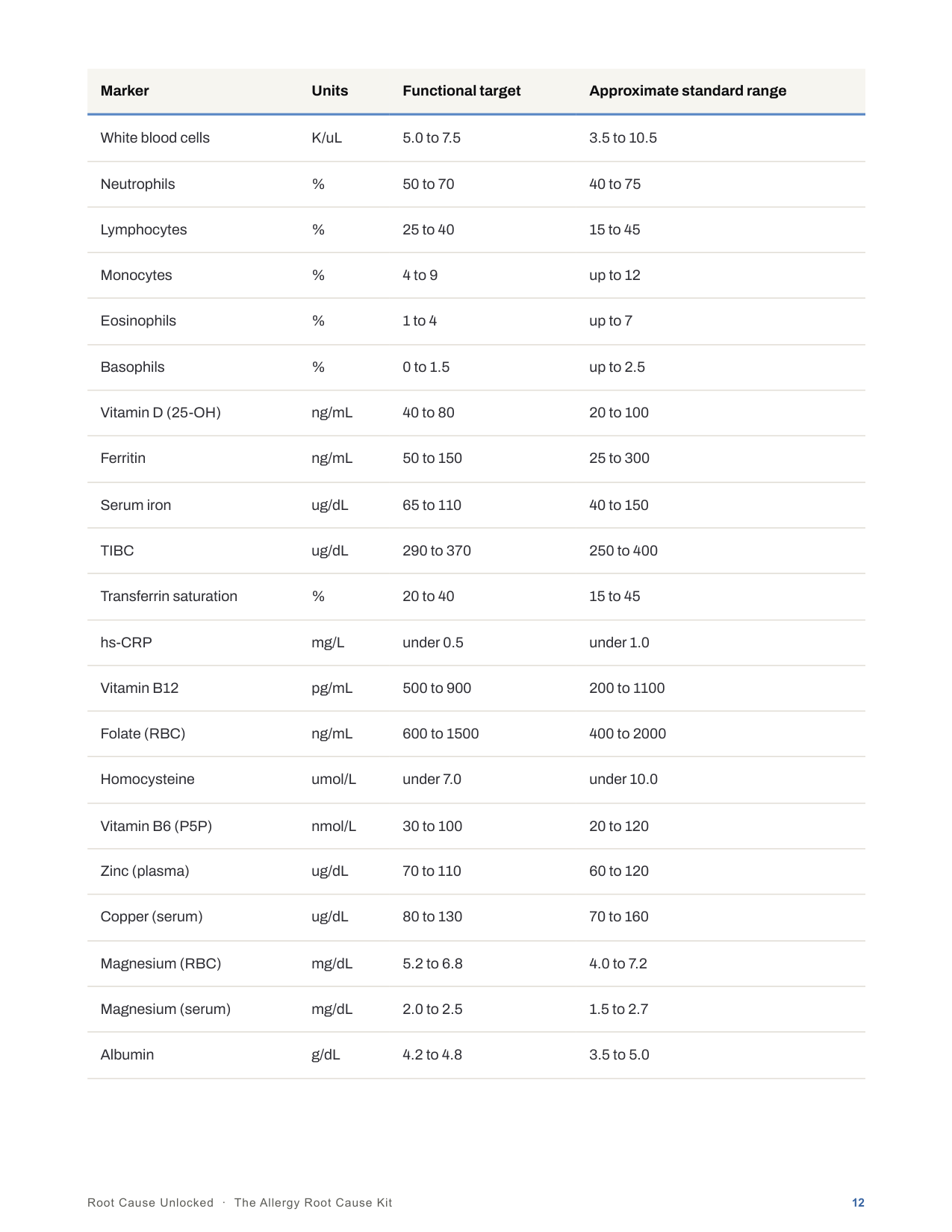
Ordering a test and knowing what to do with the result are two different things. Bring your results to your physician, or to a Discovery Session, before you act on them.